How AI-powered experimentation is taking CX beyond basic testing — and what that shift means for product and growth teams
Traditionally, customer experience (CX) optimization means finding a ‘one-size-fits-most’ solution. Product and growth teams create two versions of a campaign, split their audience into segments, measure which version performs better, and apply the winner universally. It’s the basic logic behind A/B testing, and it’s been the foundation of experimentation in CX for years.
But in the age of AI, the old A/B testing playbook has a flaw: aiming for ‘one-size-fits-most’ usually means you end up fitting no one at all.
The problem is that group-level experimentation treats every individual within a segment as interchangeable. For example, “high-intent female shopper aged 25-34” is a useful category for testing purposes, but it papers over the reality that two people matching that description may respond very differently to the same message, the same tone, the same call to action, or even the same channel — based on differences in context, behavioral patterns, past brand interactions, or any other personal characteristic that doesn’t map neatly to a demographic profile.
The next generation of AI-powered experimentation is designed to address this gap. Instead of testing at the segment level and applying the results across the board, the emerging approach operates at the level of the individual: learning what works for each specific customer and adapting in real time to provide it. It’s a truly one-size-fits-one approach.
Below, we explore what individual-level optimization actually involves, what technology makes it possible, and why it represents a meaningful shift in the way product and growth teams think about experimentation and personalization.
Agentic AI in CX playbook

What does segment-level experimentation get right, and where does it fall short?
Segment-level experimentation has rightfully earned a place in the CX toolkit. It’s structured, measurable, and easily understood by product and growth teams alike. Moreover, the process is straightforward: you form a hypothesis, create variants, split your audience, and analyze the results. The methodology is sound, and for many use cases, it delivers genuine insights.
But the approach carries one inherent structural constraint. It assumes that the best-performing variant for a group is the best-performing variant for everyone in that group. In practice, that assumption starts to break down at scale.
Say a team runs an A/B test on a push notification for a flash sale. Variant A uses an urgent tone with a message that time is running out. Variant B is more casual and benefit-focused. Variant A wins the test with a higher click-through rate, so the team rolls it out to the full audience.
Within that audience, however, there are people who consistently ignore urgency-driven messaging and respond more strongly to value-led offers. There are people who respond better to shorter content, and those who engage deeply with longer stories. There are customers who prefer to be reached in the morning, and others who tend to convert late at night. A segment-level test alone can’t surface those patterns, because it’s designed to find the single best answer for an entire group, not the best answer for each individual within it.
For teams running a handful of campaigns, this may be an acceptable tradeoff. But for enterprise brands managing thousands of customer interactions across multiple channels, the gap between “best for the group” and “best for the individual” represents a real cost. It can add up to missed conversions, lower lifetime value, and customer experiences that feel generic instead of unique.
What does individual-level optimization do differently?
Individual-level optimization uses AI to learn what works for each specific customer and adjust their experience accordingly, rather than finding the best-performing variant for a group and applying it uniformly.
In practice, this means adopting AI that can dynamically adapt multiple dimensions of a customer’s experience based on what it’s learned about that person’s behavior and preferences.
Those dimensions might include:
- Voice and tone: Does this individual respond better to direct, action-oriented language or something warmer and more conversational?
- Content length: Does a short, punchy message get more engagement, or does this individual need more context and detail before they act?
- Calls to action: Which CTA format drives the most conversions for this individual? Do they respond to bold buttons, text links, limited-time offers, or softer prompts to “learn more?”
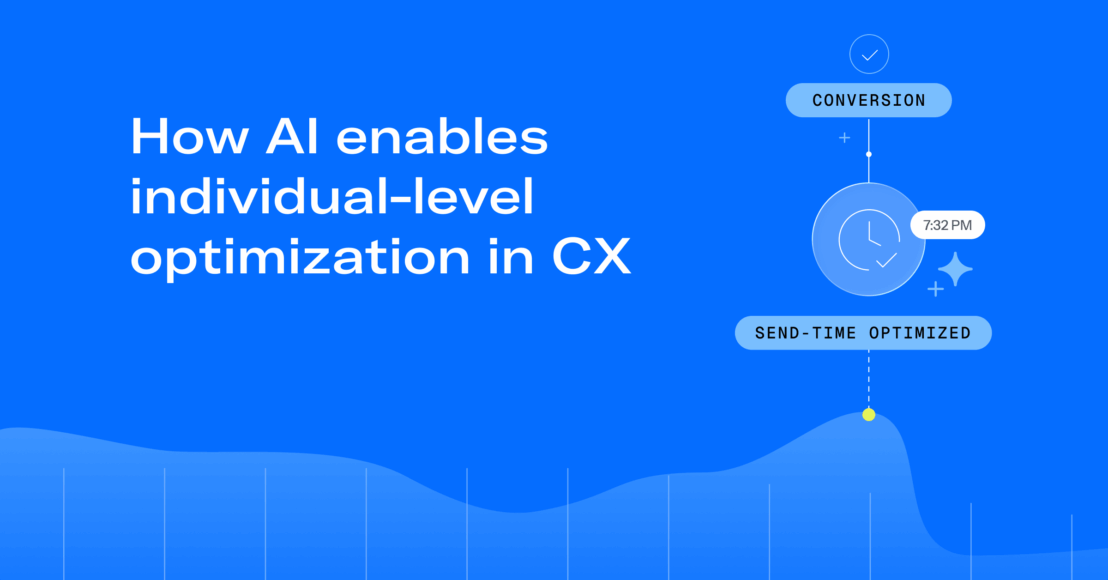
- Timing: When is this individual most likely to engage? Is it during their morning commute, while they’re on their lunch break, or in the evening as they wind down?
- Channel: Does this individual respond better to push notifications, in-app messages, emails, SMS, or some combination? Does that preference change depending on what is being communicated?
The key difference from traditional A/B experimentation is that the system isn’t running discrete tests and applying the results after the fact. It’s learning continuously from each individual’s behavior and making adjustments in real time. Every interaction generates a signal, and that signal feeds back into the system’s understanding of what that specific customer is likely to respond to next.
How does the technology behind individual-level optimization work?
Making decisions at the individual level requires AI tools that can process and interpret a wide range of signals across each customer. That’s a harder technical problem than it might seem, because most of the data that CX platforms collect — like behavioral events, content interactions, purchase histories, and channel-by-channel engagement patterns — isn’t in a format AI models can directly reason around.
The foundational technology enabling this shift is something called vector embeddings.
Essentially, vector embeddings are a way of converting complex, unstructured information — like a piece of content, a customer’s behavioral patterns, or a set of engagement signals — into a numerical format that AI models can work with. They translate qualitative information into quantitative terms that machines can understand, compare, and make concrete decisions about.
That matters for individual-level optimization because, once a platform can convert customer signals into numerical representations, it can start identifying patterns at a level of granularity that wasn’t possible before. So, instead of asking, “Which message performs best for 25- to 34-year-old women?,” the system can ask, “What does this specific customer’s behavior tell us about the tone, message length, CTA, timing, and channel she’s most likely to respond to right now?”
This doesn’t happen all at once. In practice, the most effective approach begins where signals are strongest — that is, where platforms have the most data and patterns are easiest to detect. That might look something like this:
Phase 1: Content-level decisions
Generally, it starts with content-level factors like tone, message length, and CTA format, since most platforms already have robust engagement data around these points. For instance, an AI-powered experimentation engine might identify that a specific customer clicks through on short, direct messages with bold CTAs but ignores longer, benefit-led copy. That insight is then applied automatically the next time that customer is reached.
Phase 2: Channel and timing decisions
As the experimentation engine accumulates more individual-level data, it can expand to optimizing when and where to reach each customer. One customer might consistently open push notifications in the morning but engage with emails in the evening. Another might ignore emails entirely but respond to in-app messages during specific sessions. These patterns emerge at the individual level, not at the segment level, and they tend to shift over time.
Phase 3: Journey-level decisions
The ultimate goal is full orchestration at the individual level. At that stage, the system doesn’t only optimize individual messages or interactions, but adapts the entire sequence and flow of a customer’s experience based on what it has learned about them. This is the most ambitious frontier, and it requires solving the hardest underlying problem: making sense of customer data in real time and assigning context and value to incoming signals relative to specific business goals.
Multiple agents. One system.

What does the shift from segment- to individual-level optimization mean for product and growth teams?
More than just a technical upgrade, individual-level optimization transforms the way brand teams think about experimentation, personalization, and what “optimization” means. This has several practical benefits:
- Experimentation becomes continuous rather than episodic.
In a segment-level model, experimentation is a discrete activity. You design a test, run it for a set period, analyze the results, and apply the findings. In an individual-level model, every interaction is part of an ongoing experiment. The system is always learning and always adjusting. This doesn’t eliminate the need for strategic experimentation, but it does mean the day-to-day optimization is happening automatically in the background.
- Personalization becomes real rather than approximate.
Most of what gets called “personalization” in CX today is actually segmentation. It’s grouping people by shared attributes and serving them all the same content. Individual-level optimization moves closer to personalization in the truest sense. It’s an experience tailored to what the system has learned about a specific person, not just the group they belong to.
- The team’s role can shift from execution to strategy.
When an AI system handles the granular decisions about tone, timing, length, and CTA for each customer, the human team’s role evolves. Instead of spending time creating and managing variants for A/B tests, teams can focus on higher-level strategic questions, like which goals to pursue, which customer segments to prioritize, which brand standards to maintain, and where to direct AI efforts for the greatest business impact.
- Results compound over time.
Because the AI system is learning from every interaction at an individual level, the quality of its decisions improves continuously. A platform that’s been optimizing for an individual customer over six months or more has a meaningfully richer understanding of that person than one that started yesterday (or not at all). That compounding effect creates a strategic advantage that grows along with usage.
What strong individual-level optimization looks like in practice
As personalization becomes a more common claim in the CX market, it’s worth considering what platforms that have genuinely built individual-level optimization have in common. In practice, they share a few defining characteristics:
- It’s clear exactly what’s being personalized per customer.
Strong CX platforms don’t stop at send time or channel, but also optimize tone, content length, and CTA at the individual level. The scope of what’s being personalized is a reliable indicator of how far the capability actually goes.
- The system learns continuously, not periodically.
Individual-level optimization depends on real-time signal processing, rather than batch updates or manual refreshes. Platforms built for this are learning from every customer interaction as it happens and adjusting accordingly.
- Experimentation is connected to the broader AI architecture.
Individual-level optimization has the most impact when it’s part of an integrated system, where insights from experimentation feed directly into recommendation agents, content agents, journey agents, and other tools that can act on them immediately. A standalone feature with no integration into the rest of the platform is unlikely to deliver compounding results.
- Optimization is aimed at outcomes, not engagement metrics.
The strongest CX platforms build individual-level optimization around specific, measurable business goals (like repeatable conversions, retention rates, and customer lifetime value) rather than open rates and click-through rates. Better engagement numbers at the individual level are only meaningful if they’re tied to results that actually matter for the business.
Where Airship is taking individual-level optimization
All of these capabilities — moving from segment-level to individual-level experimentation, using behavioral signals to adapt experiences in real time, and progressing from content and timing decisions to full journey orchestration — represent the destinations Airship is actively building toward every day.
Airship’s industry-first AI agents are already collaborating across the entire customer journey, with recommendation agents identifying opportunities, campaign and journey agents building personalized experiences, brand guidelines and accessibility agents reviewing outputs in real time, and experimentation agents running continuous tests to optimize for meaningful business outcomes. This agentic architecture provides the foundation for individual-level optimization, because the infrastructure for context-passing and continuous learning is already in place.
The next step is extending experimentation to the individual level. That starts with the dimensions where Airship already has strong signals, like how individual customers respond to different tones, content lengths, and CTAs. From there, the platform expands naturally to channel selection, timing, and eventually journey-level decisions. As with Airship’s approach to agentic AI, optimization solutions are purpose-built, grounded in 15+ years of mobile CX expertise and innovation, and rooted in goal orientation to drive real results. The aim is to learn what drives the best outcome for each individual customer relative to the brand’s objectives and act on that learning automatically, with a human always in the loop.
Complete, individual-level journey orchestration is the end goal the entire industry is working toward — and, transparently, no platform has fully delivered it yet. But the platforms that are already shipping purpose-built agents, building the data infrastructure to support individual-level learning, and grounding their AI in deep domain expertise are in a fundamentally different position than the ones still assembling the initial pieces and tacking them on to legacy systems.
See how Airship’s AI is evolving
Explore Airship’s AI capabilities on our AI platform page — or get in touch with our team to learn more about how we’re building toward full individual-level optimization and what that could mean for your brand.
If you want to dive deeper into the benefits of mobile-first, cross-channel customer experiences, read our full playbook for product and growth teams.