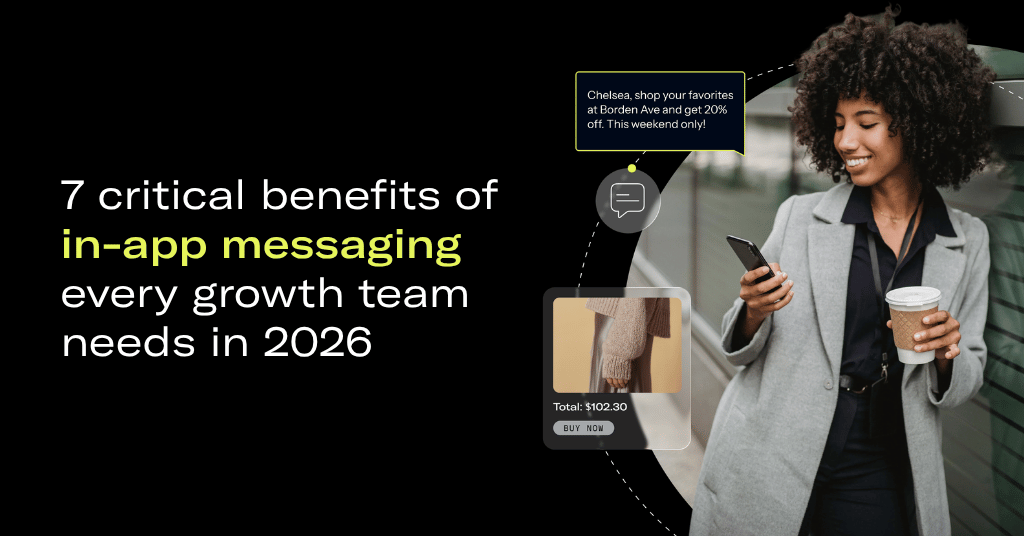
Benefits of in-app messaging at a glance:
- Bridge the opt-in gap: Communicate with 100% of your active audience by bypassing system permissions that limit push notifications to roughly half of your users.
- Drive measurable ROI: Retailers using in-app messaging see a 140% increase in purchase frequency compared to those who do not.
- Capture zero-party data: Use interactive, no-code Scenes to gather explicitly shared user preferences, leading to conversion rates 8X higher than standard push.
- Operational agility: Scale faster by using no-code editors to build and deploy native-feeling experiences in minutes rather than months.
If you’re measuring your mobile customer experience by how many push notifications you fire off, you’re missing half the picture. While you may already understand what in-app messaging is, the real competitive advantage in 2026 is found in the “inner loop” of the app experience. By orchestrating moments of value while a user is active, brands are transforming passive sessions into high-velocity revenue events, reaching the roughly 50% of users who have opted out of lock-screen alerts.
1. Reach 100% of your active audience
In-app messaging allows you to communicate with your entire active user base, regardless of their push notification status. Because these messages are native to the app’s code rather than the device’s operating system, they do not require strict system permissions. With median push opt-in rates sitting at approximately 51% in 2026, this ensures you are no longer leaving half of your audience “invisible” during high-intent sessions.
2. Drive significant lifts in session frequency and MAU
By delivering contextual value, brands can effectively train users to return to the app more often. Airship research shows that brands utilizing in-app messaging see 72% more Monthly Active Users (MAU) than those that do not. Specifically, customers who engage with in-app promotional content have been found to have 2x more sessions in the following month compared to those who do not.
3. Accelerate purchase frequency and AOV
In-app messaging strikes when user intent is at its peak, leading to immediate bottom-line impact. Retailers leveraging in-session messages see customers purchase 140% more frequently than those who do not. Furthermore, leading beauty retailers have observed a 5% higher Average Order Value (AOV) and a 9% increase in “Add to Cart” actions among users exposed to orchestrated in-app experiences.
4. Capture high-intent zero-party data at scale
In-app messaging is the ultimate tool for “gamifying” the value exchange between a brand and its customers. By using interactive Scenes and surveys to ask for preferences while a user is already engaged, brands can see a 30X increase in survey completions compared to legacy methods. For example, Ulta Beauty used this strategy to gather over 825,000 guest preferences, allowing for hyper-personalized retargeting.
Read more

5. Reduce technical debt with no-code agility
Modern in-app messaging platforms decouple content creation from development cycles, allowing marketing teams to move at market speed. Using no-code editors, teams can build, test, and deploy rich, multi-screen experiences in minutes instead of months. OneFootball leveraged this agility to take massive content campaigns from concept to live deployment in just two weeks, bypassing traditional engineering bottlenecks.
Read more

6. Optimize the “Anonymous to Identified” transition
The onboarding phase is the most critical window for securing long-term loyalty. Brands that run orchestrated onboarding campaigns via in-app messaging see 73% higher Identified User Coverage than their category peers. In specific sectors like News and Sports, this identification lift can reach as high as 272%, allowing brands to bridge the gap between unknown visitors and loyal, logged-in customers.
7. Boost app store ratings and sentiment
By triggering feedback requests after a positive behavioral milestone — rather than at random — brands can significantly improve their public reputation. Using contextual in-session messages to request ratings after a successful user action has been shown to increase Play Store ratings by as much as 0.8 points. This ensures that your requests for feedback feel like a natural part of a successful journey rather than an intrusive interruption.
There are numerous benefits to in-app messaging. Still, it’s just one part of creating effective mobile-first customer experiences. Our latest playbook offers a 7-step framework to help growth teams unify siloed channels, eliminate technical debt, and build lasting loyalty using explicit, zero-party data.
Learn more