
For over a decade, Airship has delivered real business results for brands around the world. Our mobile expertise and outcome-led AI is transforming how companies gain speed to market and scale personalization. Today, we are proud to introduce Airship Decisioning AI to our Customer Experience platform with day-one support for iOS 27 and Apple Intelligence. Product and marketing teams can now execute instant, on-device decisions within any Airship Scene at the exact moment a customer forms intent — no server round-trips or developer queues required.
The problem with deciding after the fact
For years, brands have made decisions about their customers after the fact. A customer abandons a cart, and a message goes out hours later. A user churns, and a win-back campaign follows. Even the most sophisticated engagement platforms operate on a delay: the data comes back, the segments update, and then what? An email an hour later. A push tomorrow. The moment that mattered, when the customer was in your app with a question, a hesitation, or a clear intent, has already passed. And where in-the-moment logic has existed, it has been rigid rules and keyword matching that break the first time a customer describes what they want in their own words.
What changes with iOS 27 and on-device AI
With iOS 27, Apple’s on-device large language model takes a major leap forward and is now available for apps to use. That matters, because the decisions that shape a customer’s experience are moving into the moment and into the device itself.
For most product and marketing teams, though, every advance like this brings the same challenge. Putting a new model to work means new integrations to manage, new skills to learn, and engineers pulled off the core roadmap. The excitement lasts about as long as the demo.
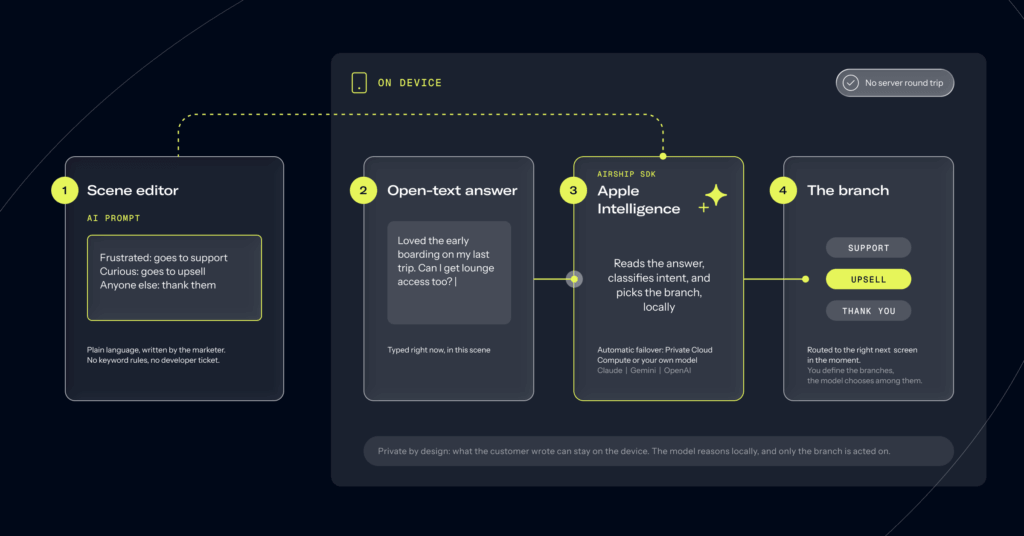
We believe no team should have to rebuild itself to benefit from the latest technology. So we did the groundwork in advance. Airship Decisioning AI runs inside the Airship SDK and uses Apple Intelligence to evaluate decisions locally, in real time, at the moment of display. Your team writes a plain-language AI prompt directly in the Scene editor, the way you would brief a colleague:
“Hold this if the customer appears to be mid-checkout.”
“Frustrated goes to support. Curious goes to the upsell.”
“Pick the offer most relevant to a budget-conscious frequent traveler.”
These are not audience conditions or trigger rules. They are instructions to an AI model, and they require no prompt engineering. At the moment a Scene would display, Airship Decisioning AI reads the live in-app context, applies your prompt, and makes the call: show, hold, branch, or select. You define every outcome the model can choose from. It picks among the options you set.
Why on-device decisioning matters
Moving decisioning onto the device is not just a technical milestone. It changes what a product or marketing team can do without filing a ticket. Move from reacting to your customer, to responding intelligently in real time.
- It is instant. Decisions happen on the device with no server round-trip, so the experience adapts in the moment, intelligently based on the customer behavior.
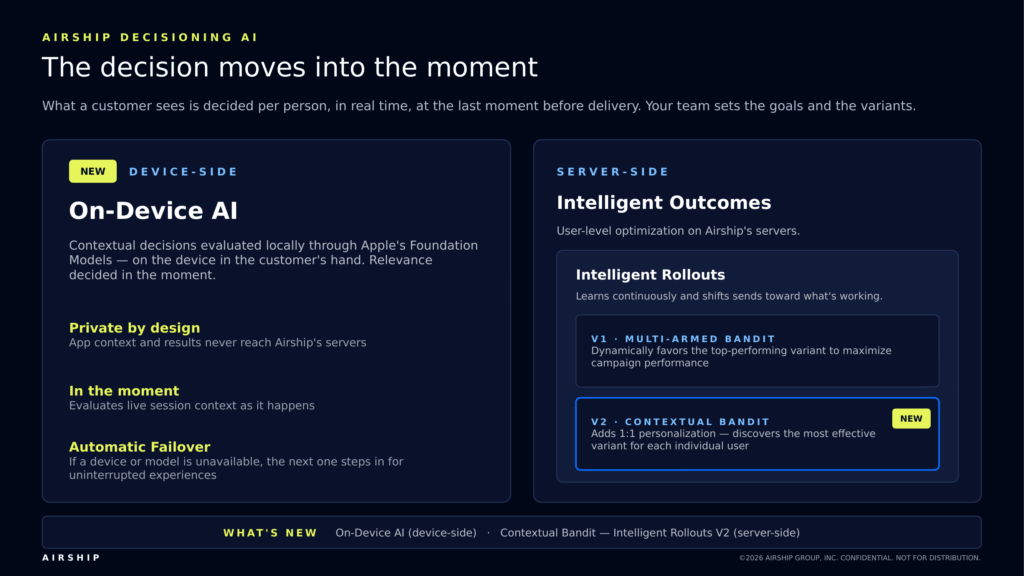
- It sees the moment. Airship Decisioning AI evaluates what is happening right now: the current screen, cart status, session activity, the words a customer just typed. This context exists only inside the session. It can be combined with what you already know about the customer, such as stored attributes and profile data, to inform the decision.
- It is private by design. For use cases where privacy is paramount, you can configure decisioning so in-session context never leaves the device. The model reasons locally and only the outcome is acted on. When you want the decision and its rationale back for reporting or downstream orchestration, you can wire it up that way. As with the rest of Airship’s AI, governance is documented for the teams who have to sign off.
Built for flexibility and choice from day one
Apple Intelligence support arrives first, but Airship Decisioning AI is built as one framework that works with the models your stack already uses:
- On-device by default. Latency-sensitive decisions run on Apple Intelligence: instant, private, and working offline.
- Bring your own model. Decisions that need more context or depth can route to Apple Private Cloud Compute or to your preferred cloud model, including Claude, Gemini, and OpenAI.
- Automatic failover. If a device does not support Apple Intelligence, or a model is unavailable, the next one in the chain steps in and the experience keeps working.
You write the prompt once. The framework runs it on the best available model. Android support via Google’s on-device model is next, and bring-your-own-model support — available now for iOS — will extend to Android and the Airship Web SDK in future releases. Your prompts work unchanged as new models come online.
Three ways to use it today
Airship Decisioning AI launches with three capabilities, each available on any experience powered by Airship Scenes.
| Capability | How it works |
|---|---|
Contextual Hold AI | Reads what the customer is doing right now and holds a Scene if the moment is wrong. You describe the moment to avoid. A promotion for an add-on or upgrade waits until the customer has finished checking out, rather than interrupting the task they came to do. |
Branching AI | Classifies open-text answers and routes each customer to the right next screen, with no keyword rules. You define the branches. A feedback form asks customers to describe their experience in their own words, and the model sorts each response by what it is actually about, then routes it to the follow-up you built for it: a support path, a recognition form, or a simple thank-you. A "what are you looking for?" |
Selection AI | Ranks competing content for a slot and surfaces whichever is most relevant to that customer right now, re-ranking as new content arrives. You supply the content and the goal. When a loyalty bonus, an upgrade offer, and a destination deal are all competing for the same home screen space, the model picks the one that fits this customer's context and history. |
One decisioning layer
Airship Decisioning AI is the next step in a broader vision. Intelligent Outcomes, powered by our Contextual Bandit pipeline, learns what works for each customer over time and continuously shifts toward what is performing. On-device AI adds what server-side optimization alone cannot see: what is happening in this session, right now. Together they form a single decisioning layer. Historical intelligence plus in-the-moment awareness, choosing the next best action for every customer.
Think about what that opens up. The offer that makes sense after a delayed flight. The size that is in stock at the store the customer is standing in. Relevance decided in the moment, because a moment is all it lasts.
This industry keeps score by who launches first. We would rather be the platform that makes new technology usable first, because a capability nobody can operate is not an advantage. With iOS 27, that means a goal set in the morning, a prompt written by lunch, and a smarter experience live in your app without pulling anyone from the roadmap.
You set the goals and write the prompts. The AI makes the call in the moment, within the options you defined. Your team stays in control, with no prompt engineering, no developer tickets, and no waiting on app store updates.
Airship Decisioning AI is available now with day-one support for iOS 27 and Apple Intelligence.