
No matter how you feel about cookies (the third-party ones, not the baked kind), they’re becoming increasingly ineffective. In fact, a “cookieless” future is something product, growth, and marketing teams need to prepare for now, not later.
In this guide, I first introduce what exactly a cookieless future entails and how that will impact businesses. Finally, I introduce a step-by-step framework based on my experience collecting and activating millions of data points.
A cookieless future is on the near horizon. Let’s get you prepared.
What does a “cookieless” future mean?
A cookieless future means digital tracking tools like third-party cookies and tracking pixels are obsolete due to privacy regulations and platform changes. Brands must stop guessing customer intent through inferred tracking data and instead gather zero-party preferences directly from users within owned spaces.
Relying on tracking pixels captures what someone did rather than understanding what they want. Third-party tracking often causes friction and misinterprets intent, leading to wasted spend. In fact, 61% of consumers find ads driven by third-party tracking to be intrusive or creepy.
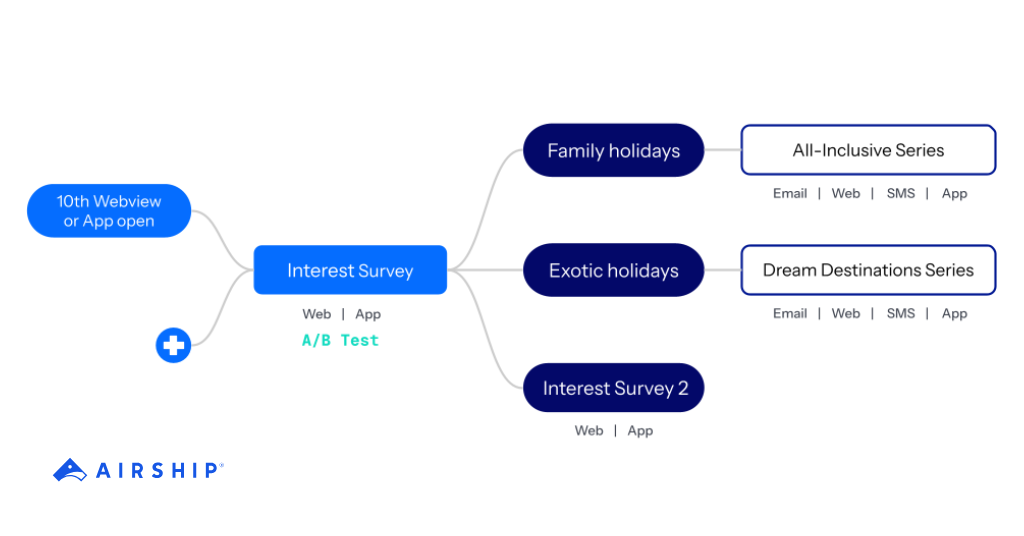
When I discuss the deprecation of cookies with customers, I try to position this as a positive change. It enables growth teams to pursue more effective data collection and activation strategies, such as deploying in-app surveys to collect user preferences. Ulta Beauty did exactly that. With Airship, they collected over 825K+ preferences for their mascara products, more than doubling their conversion rates with a hyperpersonalized retargeting campaign.
The cookieless future forces an essential shift — moving away from inferred guessing toward explicit data collection. Growth teams must pivot from tracking behavior to orchestrating experiences built on explicit trust.
Our team was able to build a new and innovative experience for our guests when they were actively engaged with our app, capturing valuable insights to deliver more tailored recommendations.”

Navigating the privacy shift with zero-party data
- Mobile moats: Your mobile app acts as a protected ecosystem to collect preferences safely with full customer consent.
- Granular Preference Centers: Give users direct control to choose their message frequencies across app alerts, SMS updates, and email channels.
- Interactive in-app surveys: Use native modules to directly ask customers about their interests, removing conversion guesswork.
- How to execute without dev bottlenecks: Building these native touchpoints traditionally requires heavy engineering resources and app store approval cycles. With a no-code experience editor like Airship, product and growth teams can design, test, and deploy fully native in-app surveys, preference centers, and custom scenes in seconds, zero coding required.
I always reference professional sports and media apps as a prime example of how to effectively use Preference Centers, which allow these businesses to collect user preferences about their favorite team, player, and sport. Then, they can leverage that zero-party data to deploy highly personalized, relevant campaigns. Think cross-channel experiences about upcoming games featuring their favorite player or team, as opposed to generic “batch-and-blast” messaging. And this isn’t only applicable to sports. In fact, I strongly believe other verticals have the opportunity to copy this exact technique.
Why are cookies no longer effective?
Third-party cookies are losing their power because web browsers are blocking them and new privacy laws require clear user permission. This makes it difficult for companies to get tracking data, leaving teams with incomplete and lower-quality insights.
Why tracking data is disappearing
- Browser updates: Primary web platforms block third-party cookies by default to protect user data.
- Apple’s privacy rules: Apps must ask for explicit permission before tracking people across the web, and most users decline.
- Google’s platform shift: The web ecosystem continues to steadily phase out traditional tracking methods.
Privacy laws give users control
Regulations like GDPR in Europe and CCPA in California change how companies gather data. They replace passive background tracking with strict rules that favor honest, real consent.
As a result, businesses manage disconnected data streams that miss actual customer intent. Guessing at what buyers want causes teams to send mismatched promotions that drive up app uninstalls.
What is the impact of a cookieless future on growth teams?
The impact of a cookieless future is the permanent decline of third-party data availability and tracking utility across digital platforms. Growth teams can no longer look exclusively at cross-site tracking histories to guess consumer needs and must transition to gathering preferences directly from permissioned app experiences.
Increased reliance on zero-party data
Without third-party tracking, product, growth, and marketing teams are increasingly turning to data they own and collect, also known as zero-party data. This means creating customer experiences based on what a user tells you (zero-party) instead of what they did (third-party).
- The data: According to one study, 77% of brands plan on increasing their investment in zero-party data.
- The tactic: Investing in platforms that enable deployment of native surveys such as Airship, a mobile-first cross-channel customer experience platform with survey capabilities across push, web, in-app, SMS, and email.
Compared inferred behavior to explicit choices
| Strategic attribute | Legacy third-party data | Native zero-party data |
|---|---|---|
Core definition | Guesses at customer preferences using third-party tracking scripts. | Asks about user preferences directly using surveys. |
Customer experience | Tracking customers behind the scenes makes users feel surveilled rather than understood. | Consumers willingly and proactively share explicit data in exchange for clear, personalized utility. |
Collection mechanisms | Relies on fading background web tools like cookies and tracking pixels. | Utilizes interactive preference centers and contextual in-app surveys. |
Growth team execution | Forces product leaders to build automated campaigns around inaccurate assumptions. | Allows direct user choices to guide and lead the entire mobile experience. |
Primary metric focus | Measures volume outputs like clicks, email open rates, and site traffic. | Focuses on long-term retention, lifetime value, and repeatable conversion rates. |
Let me provide a common example that shows the problems with guessing what customers want with third-party data. Say someone is shopping for a gift and browses a ton of golf items before making a purchase. That third-party data tells a brand that this person is interested in golf. But in this case, that’s not true. They were purchasing a gift for someone else. So if that same user ends up receiving a retargeted campaign about golf, there’s a high chance they’ll unsubscribe because it’s not relevant to them.
Greater use of AI-driven contextual advertising
Without cookies, growth teams are deploying campaigns that focus less on who a user is and more on where a user is, also known as Advanced Contextual Targeting. This technology uses Natural Language Processing (NLP) to determine a webpage’s sentiment, topic, and intent, automatically surfacing highly contextual ads without relying on third-party cookies.
- The data: Over 7 in 10 marketers are already using contextual data to combat the deprecation of third-party data and cookies.
- The tactic: Investing in a CX platform that leverages predictive and agentic AI to determine the optimal channel, timing, and context for campaigns, such as Airship.
Moving away from multi-touch attribution to aggregated measurement
Tracking a user’s multi-touchpoint journey, from discovery to conversion, is no longer feasible without third-party data. Instead, growth teams are investing more in Marketing Mix Modeling (MMM) and Geo-Based Incrementality Testing, frameworks that rely on macro-level data and statistical regression to measure channel performance.
- The data: According to Gartner’s 2024 Marketing Analytics Survey, nearly 7 in 10 marketing leaders intend to up their investment in marketing Mix Modelling over the next two years.
- The tactic: Unifying disconnected tools into a single cross-channel platform, like Airship, lets product and growth teams coordinate customer journeys across the app, web, push, SMS, and email together.
More strict compliance and privacy requirements
Global regulations make user consent a legal necessity. Growth teams must move away from hidden background tracking to adopt clear communication frameworks built on verified customer permissions.
- The data: Regulatory bodies in the U.S. issued more data privacy penalties in 2025 than they did over the entire preceding five-year period.
- The tactic: Utilizing an authorized customer experience platform, like Airship, lets teams manage consent rules and update consumer choices across app, SMS, and email preferences automatically.
How to prepare for a cookieless future in 2026, step-by-step
Step 1: Audit and map your third-party cookie dependency
Before deploying new solutions, you must identify where your pipeline is vulnerable to data degradation.
- The goal: Locate every client-side pixel, tag, and tracking script currently running on your website and mobile applications.
- The action: Use a tag management tool to catalog which ad platforms (e.g., Meta, Google, LinkedIn) rely on those browser cookies. Determine what percentage of your attribution data is already missing due to Safari’s ITP, Apple’s ATT, and browser ad-blockers.
| Tracking asset / tag | Primary purpose | Current mechanism | Cookieless risk level | Post-cookie solution / alternative |
|---|---|---|---|---|
Meta Pixel / LinkedIn Insight Tag | Retargeting web visitors, ad attribution, and lookalike audience building. | Client-side browser script (Third-party cookie/pixel). | High (Safari/iOS already blocking; Chrome restrictions rendering it ineffective). | Transition to Server-Side APIs (e.g., Meta Conversions API) coupled with first-party list matching. |
Google Analytics (GA4) Web Tags | Funnel tracking, traffic source identification, and user behavior analysis. | Client-side Javascript tag. | Medium (Aggregate data remains, but individual cross-site user paths become fragmented). | Implement Server-Side Google Tag Manager (sGTM) and adopt top-down Marketing Mix Modeling (MMM). |
Ad Network Retargeting Tags (e.g., Criteo, AdRoll) | Serving dynamic product ads to users who left items in a web cart. | Cross-site third-party cookie tracking. | Critical (This specific use case will completely break without cross-site data). | Pivot to Owned-Channel Automation. Capture the user's email/app download upfront and trigger abandoned cart pushes via a customer experience platform like Airship. |
Marketing Automation / CRM Trackers (e.g., Hubspot, Marketo) | Lead scoring and tracking a specific user's content history across the web. | Client-side browser cookies. | Medium-High (Anonymized traffic won't sync to CRM profiles until an explicit login occurs). | Build a transparent "Value-Exchange" onboarding flow to capture authenticated logins and zero-party preferences early. |
Step 2: Implement server-side tracking for core conversion signals
Because traditional client-side browser pixels are being blocked, growth teams must move data tracking upstream to protect ad platform optimization algorithms.
- The goal: Route essential conversion events directly from your secure server to ad networks, bypassing the web browser entirely.
- The action: Deploy Server-to-Server APIs (such as Meta’s Conversions API or Google Server-Side Tag Manager). This ensures your ad platforms still receive the conversion feedback loops they need to optimize ad spend efficiently, while remaining compliant with user privacy preferences.
Step 3: Consolidate data capture across owned channels via a customer experience platform
As third-party data tracking disappears, growth teams must prioritize building direct, permissioned relationships with users inside the digital channels they completely control.
- The goal: Shift your acquisition and retention strategies away from paid media and third-party audiences and toward deeply understood, owned-channel audiences.
- The action: Use Airship to capture data across mobile channels and native web scenes. This lets you retarget returning web visitors directly on your site based on behavior, bypassing paid ad channels like Facebook.
- The economic reality: This shift toward owned channels is financially urgent. While 60.0% of brands are increasing their mobile budget allocations, according to a joint report by Airship and EMARKETER, a staggering 76.7% still report that budget remains a primary obstacle to success.
Step 4: Revamp your user onboarding for a transparent value-exchange
If you want users to willingly hand over permissioned data and opt into push notifications, you must give them a compelling reason to do so immediately.
- The goal: Replace generic, legally vulnerable tracking opt-ins with transparent, gamified onboarding flows that reward data sharing.
- The action: Use a no-code CX platform like Airship to design interactive onboarding sequences that natively ask users for their specific interests, content preferences, and communication frequencies. Because it is a truly no-code builder, your growth team can run continuous onboarding experiments to see which value propositions yield the highest notification and location opt-in rates without waiting on developer sprints.
- The Value Exchange Matrix: Use this framework I organized to align what your growth team needs with what your users actually care about:
| What you ask for | The value exchange (what the user gets) | Growth team impact |
|---|---|---|
Push notification opt-in | “Get real-time alerts for limited-edition drops and flash sales before they sell out.” | Retention: Immediate re-engagement channel that bypasses noisy email inboxes. |
In-app Preference Center selection (zero-party data) | “Tell us your favorite style/category so we can customize your home feed and stop showing you irrelevant content.” | Personalization: Clean data profiles to power highly relevant cross-channel automated journeys. |
Location tracking permission | “Unlock real-time curbside pickup tracking and localized in-store maps/deals.” | Contextual growth: Ability to trigger hyper-targeted, location-based notifications. |
Mobile wallet pass download | “Add your loyalty card to Apple Wallet/Google Wallet for seamless one-click scanning and real-time points updates.” | LTV & utility: A persistent, dynamic lock-screen presence outside of the core app environment. |
Step 5: Switch to privacy-safe, big-picture performance measurement
Growth teams are moving away from tracking isolated, individual user journeys and are instead focusing on high-level, aggregate business impact.
- The goal: Future-proof your attribution by migrating from Multi-Touch Attribution (MTA) to aggregate performance measurement.
- The action: Adopt Marketing Mix Modeling (MMM) and Geo-Based Incrementality Testing. These frameworks use data science and statistical regression to evaluate historical sales spikes against macro-level marketing spend, completely removing individual identity tracking from your financial reporting equations.

Cookieless future FAQs
Why are digital platforms phasing out third-party cookies?
Digital platforms are phasing out third-party cookies to comply with strict privacy regulations and satisfy consumer demands for data confidentiality. Major web browsers and mobile operating systems block cross-site tracking scripts by default, moving the internet away from background data harvesting. This change eliminates third-party guesswork, forcing brands to rely on transparent, permissioned data ecosystems to connect with their audiences.
What technologies will replace third-party tracking cookies?
Third-party tracking cookies will be replaced by direct zero-party data collection tools, contextual advertising strategies, and structured server-side architectures. Contextual systems serve relevant ads based on the immediate topic a user is viewing rather than their personal digital identity. Meanwhile, growth teams are turning to native mobile apps as secure spaces to capture verified customer preferences directly through interactive consent modules.
How can brands personalize digital experiences in a cookieless future?
Brands can personalize experiences by deploying in-app choice screens and native surveys to capture zero-party preferences directly from users. By leveraging a customer experience platform like Airship, growth teams can seamlessly capture this data at scale across push, web, in-app, SMS, and email. Gathering data willingly from customers allows product teams to deliver custom rewards and tailored messages without resorting to background tracking scripts , cutting down on notification fatigue while ensuring updates remain highly relevant.
What is the difference between tracking cookies and zero-party data?
Third-party cookies track user behavior across external websites behind the scenes to compile inferred profiles based on historical actions. Zero-party data consists of specific choices, interests, and marketing preferences that a customer explicitly and willingly shares with a brand. While tracking cookies often misinterpret intent and cause user frustration, zero-party data puts the consumer in control to build lasting brand relationships.
Your mobile-first CX playbook