


A guide for product and growth teams navigating agentic AI in CX — including what’s real, what’s hype, and what’s coming next
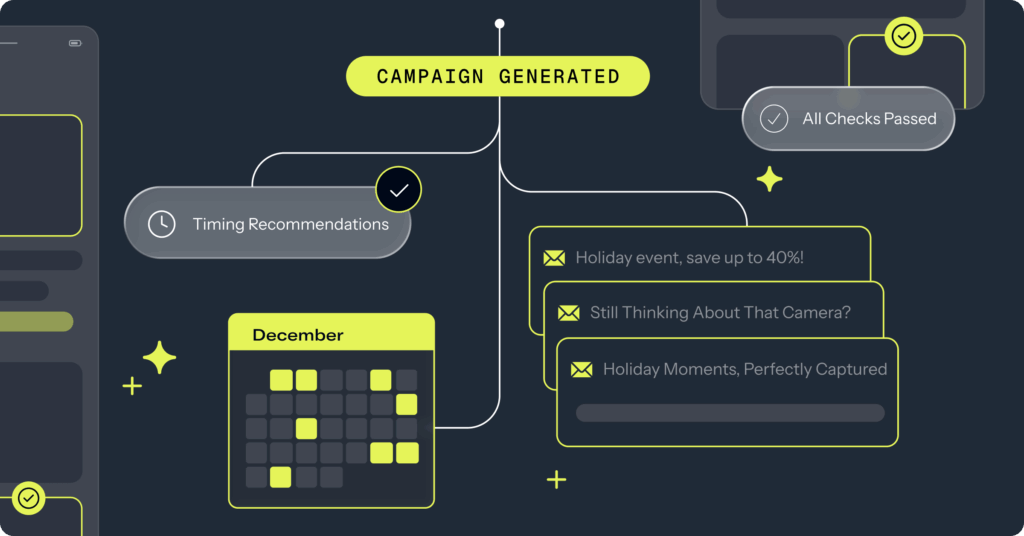
One of the most consistent challenges faced by enterprise product and growth teams is that they need to create and launch customer experiences faster at scale but don’t have the resources to do it.
The answer to this problem lies in artificial intelligence (AI).
AI technology has advanced rapidly, and its ability to automate, personalize, and optimize customer journeys is real. Still, for many teams, actually adopting AI introduces a familiar frustration in new form. Many customer experience (CX) platforms touting AI solutions still require customers to supply their own models, write and test their own prompts, validate their own outputs, and maintain their own systems. That means the efficiency gains promised by AI are often offset by the operational costs of getting it up and running.
Meanwhile, the language around AI in CX is evolving quickly. Terms like “agentic” and “autonomous” appear in many vendor decks and strategic plans, but they can mean very different things depending on where and how they’re used. That makes it difficult to tell which approaches are genuinely transforming the way teams work and which are familiar capabilities repackaged under flashy new names.
Below, we walk through the distinct types of AI, explain what agentic AI actually offers and why it matters, and consider where AI technology for customer experience is heading in the coming years.
The three types of AI in customer experience
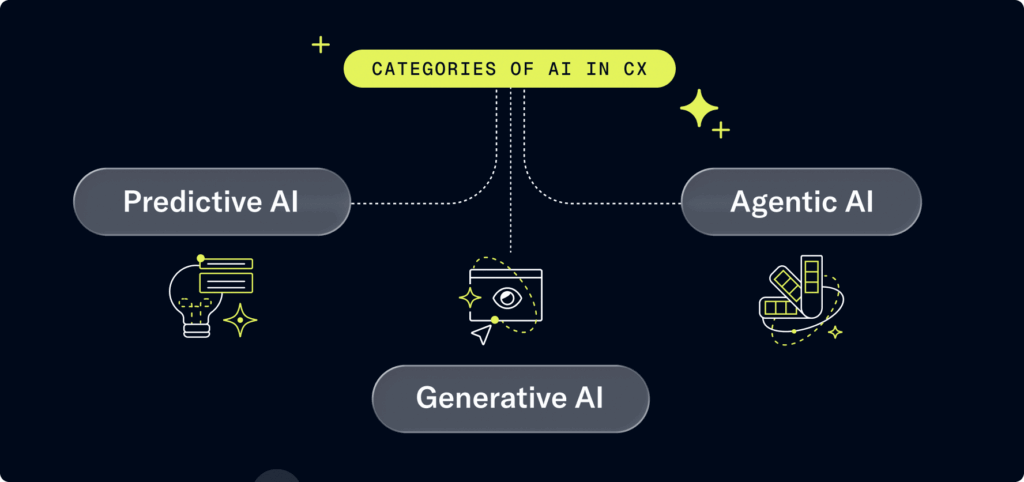
Of course, AI doesn’t refer to one specific thing. It’s a broad term, and, in the context of CX, it gets applied to a wide range of capabilities. Understanding what those capabilities are and how they differ is the first step toward making good decisions about them.
In practice, what’s marketed as AI in CX generally falls into three distinct categories.
Predictive AI for customer experience
Predictive AI is the most mature category of the three, and most established CX platforms have had some version of it in place for some time. It consists of machine learning algorithms that analyze historical data patterns to forecast future actions and behaviors, including churn probability, optimal send times, and likelihood to purchase. Predictive AI is genuinely useful, but it’s far from new. Calling a platform “AI-powered” on the strength of predictive capabilities alone is accurate in the strictest sense, but it’s not a meaningful differentiator in 2026.
Generative AI for customer experience
Most platforms have integrated some form of generative AI (genAI) by now, often through third-party large language models (LLMs) like ChatGPT, Claude, or Gemini, which can produce text, images, and other content based on human-entered prompts. In the CX space, this typically manifests as AI-assisted copy generation. Teams specify a tone and topic, and the platform produces message variations for push notifications, emails, in-app content, and more. GenAI delivers real productivity gains for product and growth teams by accelerating content creation. Whether it’s the right content for the right moment is a separate question, and it’s one that genAI alone can’t answer.
Agentic AI for customer experience
In CX, agentic AI refers to purpose-built, specialized agents that handle discrete tasks on their own but also communicate and work together toward a larger goal. For instance, a recommendation agent identifies what a customer is most likely to respond to. From there, a content agent builds the experience, while a brand guidelines agent checks it for consistency and an accessibility agent confirms compliance. Each of these agents passes on context to the next, so they can build on one another’s outputs to achieve a shared objective.
Agentic AI is the category where the gap between marketing hype and technical reality is widest. It deserves particular scrutiny because a significant share of what’s currently positioned as agentic is actually something else entirely. When a platform claims to provide agentic “next best action,” the underlying technology is often driving to the next best channel. That’s essentially rule-based logic that determines whether to send a push notification or an email, relabeled with more exciting terminology. That kind of routing has existed for years, and it’s not the same thing as independent agents making coordinated, user-level decisions.
A few questions can help clarify what’s behind a vendor’s agentic AI claims:
- Do your “agents” communicate with each other?
- Do they make real-time decisions at the individual user level?
- Are agents purpose-built for a particular use case, or are users expected to supply their own model, write their own prompts, and validate their own outputs?
The answers will reveal whether a platform is dealing in genuine agentic AI or just an old capability rebranded with a new name.
How to use agentic AI to improve customer experience
There’s a meaningful difference between a platform that has bolted AI features onto a legacy product and one that has woven AI deeply into the way the product operates — and it surfaces in three key areas. Not every platform will approach these areas the same way, but the choices a vendor makes here will determine how much of the operational burden falls on your team versus the platform itself.
1. Domain expertise
General-purpose AI is capable but generic. When a platform requires customers to supply their own model and write their own prompts, it’s asking them to translate years of domain-specific knowledge and experience into simple instructions a language model can follow. That’s a big ask for teams that are already stretched thin.
With purpose-built AI agents, the work of testing, prompt engineering, and iteration on edge cases has already been done by teams with deep knowledge of both their platform’s capabilities and their customers’ operating context. That means product and growth teams can start from a foundation of accumulated expertise, rather than a blank slate.
2. Agent cooperation
With most CX platforms, AI features exist in isolation. You might see a text generator in one part of the interface, a send-time optimizer in another, and a recommendation engine on a separate screen, with none of these sharing context with the others. That means the recommendation engine has no awareness of what the content generator just produced, and neither knows what the brand guidelines require.
In a genuinely agentic architecture, they work together. The recommendation agent identifies what a customer needs and passes that context along to the journey or content agent, which builds the experience accordingly. The brand guidelines agent and accessibility agent then review the output before it reaches the end customer. Each agent is specific and focused, handling a single task well, but together they produce a result that no one agent could achieve independently.
3. Destination layers
Most AI discussions in CX revolve around messaging, including what to send, when to send it, and which channel to use. But messages are only one part of the equation. What the customer sees and does once those messages arrive is equally (if not more) important.
Some CX offerings include the ability to build dynamic, native experiences for app and web directly within the platform, including no-code forms, surveys, branching layouts, and embedded content. When that capability is present, AI can optimize the destination as well as the outreach, testing what the customer sees when they arrive, personalizing the experience at the individual level, and iterating in real time. Without it, a platform’s AI capabilities effectively end at the message layer, leaving a significant part of the customer journey unoptimized.
The question that matters most: How to choose an agentic AI-ready platform

A useful way to differentiate between AI approaches in CX is to look at what question a platform asks first.
- If a platform leads with, “What do you want to say?” or “Which channel do you want to use?,” it’s designed to help teams send messages more efficiently. That’s valuable, but it’s really just a productivity function.
- If a platform leads with, “What’s your goal?” or “What are you trying to achieve?,” the underlying architecture is organized differently. Its AI agents are working backward from a concrete business outcome (like a conversion, retention milestone, or revenue target) and making decisions toward that end at every step.
The distinction between platforms organized around messaging throughput and platforms organized around business outcomes is more durable and more telling than any single feature. With AI advancing rapidly, every CX platform will eventually offer generative content, send-time optimization, and recommendation logic. Architecture that orients all of those capabilities around measurable results is much harder to replicate.
When the entire system is structured around a concrete end goal, AI functions as a strategic lever rather than a production tool. It shifts a platform’s role from helping teams do more to helping them achieve more, which is a meaningful difference when customer attention is increasingly expensive and customer tolerance for irrelevant experience is increasingly thin.
The agentic AI factors enterprise teams should be evaluating
For product and growth leaders assessing AI capabilities and CX platforms, the following framework can help separate substance from hype.
Ask what’s actually live
Product roadmaps help you understand a platform’s investments, but shipped products actually get the job done. Ask which AI capabilities customers can use today, how many customers are actively using them, and whether you can see them working in an actual production environment.
Understand what type of AI is being offered
Is it predictive, generative, agentic, or a combination of the three? All of these categories have value, but if predictive capabilities are being positioned as “agentic,” that’s worth examining more closely.
Ask who built it and who maintains it
If the answer is “your team,” consider whether you have the bandwidth and the skill sets to supply models, write prompts, test outputs, and maintain the system over time. Purpose-built, live AI agents that come pre-grounded and pre-tested ask something very different of your already time-strapped organization.
Evaluate whether a human stays in the loop
How does the platform handle brand safety, compliance, and quality control? What happens when the AI gets something wrong? For enterprise brands, the human-in-the-loop factor should be a critical risk management function, not an afterthought.
Evaluate the underlying architecture, not just the feature list
Features will eventually converge across different platforms. What will be harder to replicate is a system that organizes every AI capability around measurable business outcomes rather than messaging volumes.
Start now
The organizations and platforms building AI into their workflows today — including testing, learning, and developing an internal point of view — will be far ahead tomorrow. You can begin strategically with the use cases where AI is most mature and risk is most manageable, then build institutional knowledge from there.
Human-in-the-loop AI: Why it matters for enterprise CX
A common thread in AI marketing positions full autonomy as a desirable end goal. On the surface, requiring no human approvals, no campaign calendars, and no manual interventions seems like an appealing narrative. But, for enterprise brands operating at scale, it’s also premature.
Large companies have invested many years and significant resources in building their brand identities, including color palettes, design and voice guidelines, accessibility standards, and regulatory frameworks. Against that backdrop, an autonomous AI model that hallucinates, sends off-brand messages to millions of loyal customers, or violates an important compliance standard creates a business-level incident.
Rather than a point against AI, this underlines the importance of designing AI deployment to match enterprise risk profiles. The most effective agentic AI implementations build with a human-in-the-loop model from the start, recognizing that agents will not produce the right output every time. At least, not yet.
The real question for enterprise leaders is whether their CX platform is designed to catch errors before they reach customers. At minimum, that means brand guidelines agents reviewing output in real time, accessibility agents flagging compliance gaps before launch, and human approval workflows that provide oversight without creating operational bottlenecks.
The aim is to elevate a team’s role from execution to judgment. AI handles creation, optimization, and experimentation, while the team handles the decisions that require human context — like brand direction, strategic priorities, and customer understanding. That allocation of responsibility is where the real efficiency gains reside.
The future of agentic AI in customer experience
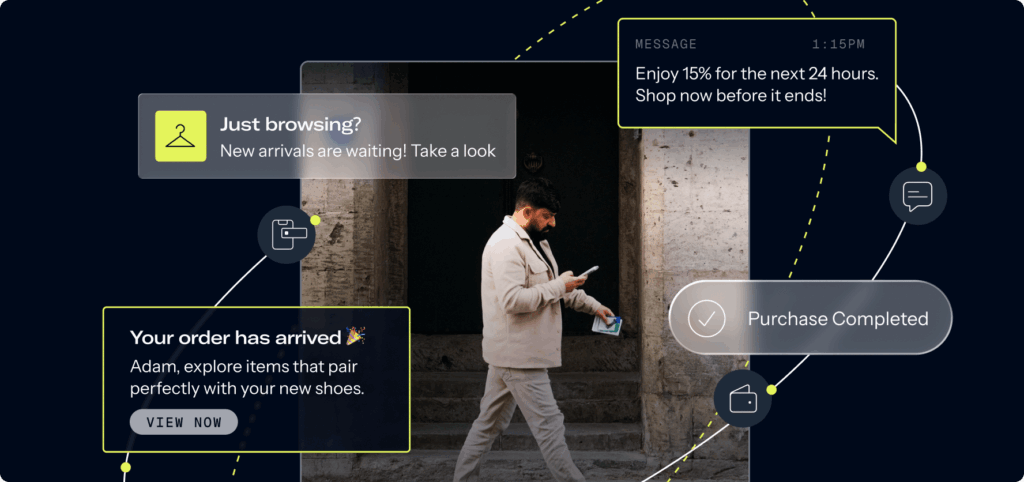
The current generation of agentic AI is already delivering measurable value, including faster campaign creation, more precise recommendations, and native content that adapts to individual users. But understanding where AI technology is going is just as important as understanding where it is today.
Here’s what’s on the horizon.
Individual-level experimentation
Today, most experimentation in CX happens at the segment level, like A/B tests that compare how a group of customers responds to one message versus another. It’s a proven approach, but it’s broad and nonspecific. The next generation of AI-powered experimentation will operate at the level of the individual, dynamically adjusting things like tone, message length, call to action, timing, and channel based on what the system has learned about each individual customer.
The technology behind this is already being built. By converting content and behavioral signals into numerical formats that AI models can reason around, platforms are developing the ability to learn what works for each person, not just each audience segment. The early focus is on areas where there are already strong signals, like how individual customers respond to different tones, content lengths, and CTAs, with the scope expanding over time to include channel selection, timing, and eventually full journey-level decisions.
Go beyond A/B testing

The agent swarm
The trajectory of AI points toward something the industry calls the agent “swarm”: large numbers of specialized AI agents coordinating across the full customer lifecycle, from acquisition all the way through retention. In this model, each agent contributes its expertise to a unified, continuously learning system.
Airship is already shipping collaborative, purpose-built agents in their version of agent swarm, called the Airship AI Agent Fleet.
Our approach to the Airship AI Agent Fleet was a deliberate move toward a true multi-agent system where specialized agents collaborate to achieve a shared goal. With the addition of the Campaigns AI Agent, we’ve closed the gap between strategy and execution. This is enterprise-grade infrastructure that automates the heavy lifting of analysis and execution while maintaining an intentional human-in-the-loop model for brand safety and strategic oversight.
Every CX platform takes in a constant stream of customer behavior data, but raw data without context (that is, without a way to understand what a specific signal means for a specific brand’s goals) isn’t useful on its own. The CX platforms that figure out how to turn those signals into real-time, actionable intelligence for their agents will be the ones that actually deliver on what agentic AI is designed to do.
Implementation speed
There’s also implementation speed to consider. Advanced AI capabilities have limited value if deploying them for a new customer requires months of integration work. The platforms that are investing in exposing their systems through APIs, pre-built skills, and streamlined onboarding processes will be the ones that deliver value at the pace enterprise organizations require.
Finding clarity in a crowded market
AI in customer experience is growing more complex by the day. In the weeks and months to come, more platforms will claim agentic capabilities, and more marketing will blur the line between what’s available and what’s aspirational.
In this environment, look for partners and platforms that are specific where others are vague, honest about what’s working and what’s not, and focused on measurable outcomes instead of just features.
Airship has spent more than 15 years building at the intersection of mobile expertise, unified customer journeys, and emerging technologies. Our approach has stayed consistent: build what works, ground it in deep domain knowledge, and focus on the metrics that actually move businesses forward.
As the first to the CX market with AI agents in production, building with Google ADK, we’re helping enterprise teams drive real results efficiently and at scale.
Learn more about Airship’s approach to agentic AI on our platform page — or, get in touch with our team to book a demo, and see what our agents can do for your brand.