The impact of mobile-first customer experiences for travel brands
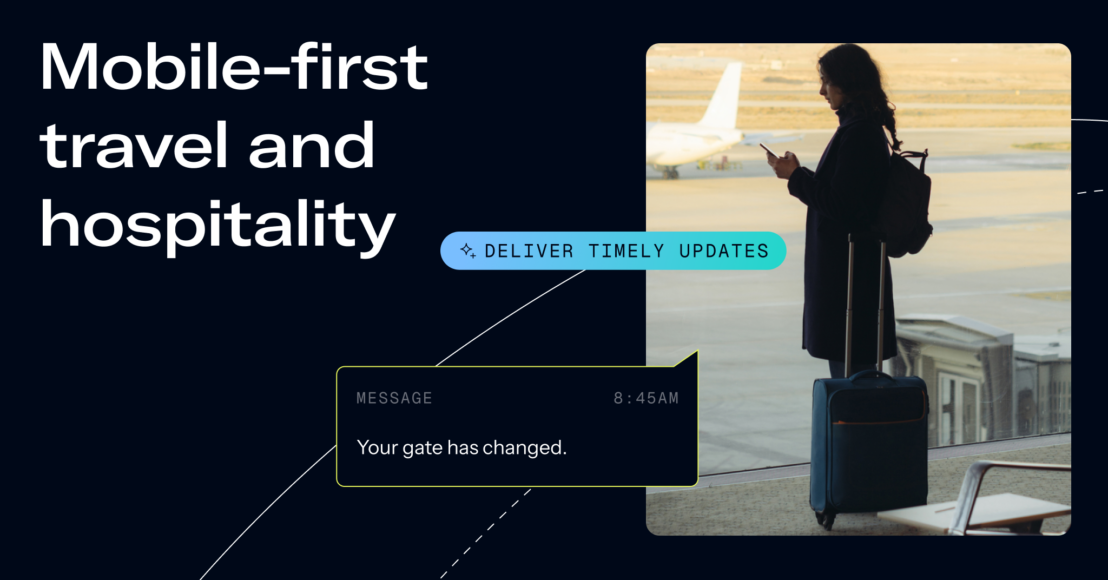
In the travel industry, the mobile experience and the product are often one and the same. A boarding pass lives in a traveler’s mobile wallet, while a gate change arrives as a push notification. Meanwhile, a room-ready alert marks the moment a hotel stay begins.
That makes it different from almost every other vertical. A retailer uses mobile to drive consumers toward a purchase. A media company uses it to deepen audience relationships with content. But, for airlines and hospitality brands, mobile is how the core product gets delivered. When the boarding pass doesn’t load, the gate change doesn’t come through, or the upgrade offer surfaces after checkout, the experience itself breaks down — along with the traveler’s trust.
Most travel brands are aware of mobile’s importance but stumble when it comes to managing it. Many still run their mobile interactions the way they run their email or desktop campaigns: planned in advance, deployed in batches, and measured through open rates and click-through rates. Push notifications are owned by one team, while wallet passes and SMS belong to another. Each channel performs reasonably well on its own, but doesn’t know exactly what the others are doing. As a result, travelers get a series of disconnected, contextless message blasts instead of a cohesive experience.
In this post, you’ll learn what it looks like when airlines and hospitality brands close the gap, when mobile stops being a collection of channels, and when a mobile-first customer experience strategy starts being the thread that ties the entire journey together.
Learn More
Every stage of a trip is a conversion opportunity
Travel has a customer journey unlike most other industries. There’s a defined arc from booking to arrival or checkout, followed by the customer’s decision whether or not to return. Each stage is a moment of high intention and high attention, which means each is also a conversion opportunity that either gets captured or gets lost.
Most travel brands capture some. Booking confirmations go out successfully, pre-departure reminders fire on time, and post-stay surveys launch a few days after checkout. But the stages in between — when a traveler is arguably most engaged, most present, and most receptive — are where the experience tends to fall apart. A seat upgrade offer might arrive after check-in has already closed. A hotel amenity recommendation might go to every guest regardless of their actual preferences. And a loyalty points reminder might go out on a generic schedule instead of the moment a member is most likely to act.
These disconnects trace back to the same structural problem: channels managed by separate teams, handled via separate tools, and optimized for separate metrics.
What mobile-first travel experiences actually deliver
The airlines and hospitality brands seeing better results have already solved for disjointed customer journeys with carefully orchestrated, mobile-first experiences.
Alaska Airlines offers a clear example. Their goal was to help passengers get more from the travel experience by streamlining the day-of-travel journey inside and outside the airport. Their team built a digital boarding and traveler credential experience through mobile wallet that moved passengers away from physical passes entirely. The result went beyond engagement metrics to genuine operational impact, with 90% of passengers opting to check in before arriving at the airport. That led to shorter lines, faster boarding times, and ultimately 35% year-over-year growth in mobile wallet adoption.
We set out to help customers unlock more value from the travel experience with a streamlined customer journey — inside and outside of the airport — creating a seamless and integrated day-of travel experience.”

Hawaiian Airlines took a similar approach to the day-of-travel experience, focusing on real-time updates and reducing traveler stress from check-in through boarding. Their cross-channel strategy — including live activities on the lock screen, Google Wallet boarding passes, and in-app automation — produced a 13% year-over-year increase in customer engagement and a 6.5x lift in registrations from customers opening the app for the first time.
The pattern across both examples is day-of-travel convenience. The mobile experiences that produce the biggest tailwinds are the ones that remove a step, answer a question before it’s asked, or deliver the right information at the precise moment a traveler needs it. That kind of outcome requires mobile interactions that are intelligently orchestrated across the full customer journey, with wallet, push, in-app experiences, and SMS working together around the traveler’s actual path. The check-in prompt should fire because the departure window is approaching. The upgrade offer should surface because the passenger is in the app. In short, the timing should follow the traveler’s real-time context, not the brand’s arbitrary schedule.
Three shifts that drive lift across the journey
You don’t need to overhaul your entire tech stack to start capturing more value. Three high-impact changes tend to move the needle most for airlines and hospitality teams making the transition to mobile-first customer experiences. These include:
1. Let the traveler’s context determine the timing
Most mobile messaging in travel is still built around campaign-level logic, including pre-departure series, post-stay follow-ups, and seasonal promotions. These campaigns aren’t wrong, but they’re designed around when brands want to communicate rather than when the traveler is most ready to act.
Journey-specific context inverts that logic by taking into account the traveler’s timing. A passenger who opened your app 40 minutes before departure is in a different headspace than one browsing at home three weeks out. A hotel guest who checked in two hours ago has different needs from one who checked out yesterday. And they should be treated that way. The infrastructure required to know the difference is intelligent cross-channel orchestration that reads behavioral signals from across different interactions before deciding what to send next. When the timing follows the traveler’s actual needs, the same message can go from an irrelevant interruption to genuinely useful information.
2. Take your mobile wallet strategy beyond the boarding pass
The mobile wallet is one of the most underutilized experience layers in travel. Most brands deploy it for boarding passes and stop there. But a wallet pass is a persistent, updatable surface that lives on the traveler’s device throughout their entire journey. Beyond the boarding pass, it can surface gate changes, loyalty balances, upgrade opportunities, post-trip offers, and more — all without requiring a traveler to open your app or act on a push notification.
The brands getting the most from mobile wallet are treating it as a real-time communication layer that extends the customer experience across the full trip arc. That only works when wallet is closely orchestrated with push notifications, in-app experiences, SMS, email, and more, so what appears on the pass reflects what’s happening across other channels in real time. Alaska Airlines’ 35% year-over-year growth in wallet adoption didn’t happen because they made boarding passes digital, but because they made the digital pass the central hub of a broader, connected travel experience.
3. Capture preferences in-journey with zero-party data for travel
Airlines and hospitality brands have historically collected customer preference data after the trip, typically through satisfaction surveys that arrive days after the travel experience has already ended. By then, the data is useful for aggregate reporting, but it’s too delayed to act on for that particular traveler on that particular journey.
In-journey preference capture changes the dynamic. An in-app experience during the booking flow can ask a passenger whether they prefer a window or aisle seat, a low or high floor, or a specific bed arrangement, all while the guest is actively engaged. That zero-party data, collected in high-attention mobile moments, can be used immediately to personalize the customer experience and stored to elevate every future interaction. It’s a personalization advantage that post-trip surveys can’t match, because it’s built from what travelers actually say they want in the moment (instead of what brands infer after the fact).
Check out our mobile-first CX playbook to go deeper into the frameworks and tools that make it all work.
Or, to see what a mobile-first customer experience strategy could look like for your brand, reach out to our team to set up a call.