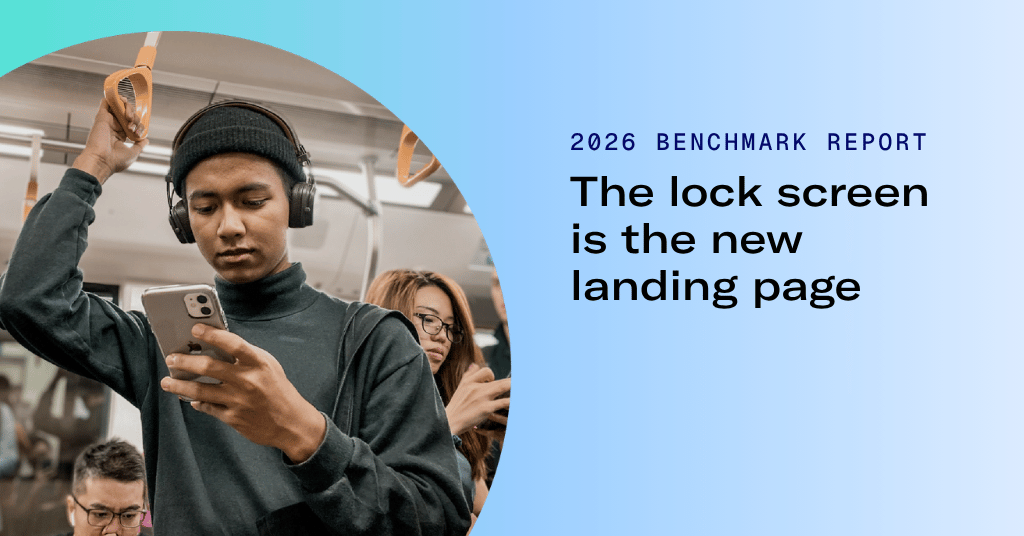
For any brand investing in mobile, whether optimizing an app today or building toward one tomorrow, one of the most valuable customer touchpoints is also one of the easiest to underestimate. It’s not a webpage, an inbox, or an ad unit — it’s the lock screen.
For customers who choose to engage with a brand on mobile, the lock screen is often where the first decision happens. When a customer sees a push notification, SMS message, or even Live Activity, they decide in less than a second whether your brand either earns another moment of attention or gets swiped into irrelevance.
The lock screen has become a front door to the mobile customer experience, and it deserves the same strategic intention as your homepage, app experience, email program, and other customer touchpoints.
When brands treat the lock screen as an afterthought, they leave one of the first moments in the mobile customer journey to chance.
What the lock screen actually represents
Many mobile teams today still view push notifications as just another way to send messages, but that undersells what’s really happening when a notification appears on a lock screen.
The customer hasn’t opened your app, nor have they searched for you or clicked an ad that put your brand in front of them. You interrupted a moment that belonged to them, and for a fraction of a second, they allowed it. That glance is the entire game.
The brands that understand this have shifted their thinking from What message should we send? to What experience are we creating in this moment? That subtle reframe changes the lock screen from a notification to an experience that sets the tone for everything moving forward.
Whether the customer journey continues in an app, an email, a mobile wallet pass, or on the web, the lock screen now represents the first opportunity to earn trust rather than just demand attention.
Nowhere is that shift more evident than in the evolution of the lock screen itself.
Live Activities turn the lock screen into an experience
Live Activities — the persistent, real-time updates that live directly on the lock screen without requiring an app to be open — show why this interface now functions more like a landing page.
A strong landing page gives customers a reason to stay engaged, return, and take the next step. Live Activities do the same from the lock screen by giving customers real-time value in a place they already check throughout the day. Instead of asking users to open an app before the experience begins, brands can use the lock screen itself to deliver utility, sustain attention, and keep customers connected to unfolding moments.
For example, a restaurant or retailer could use a Live Activity to show when an order is being prepared, when it’s ready for pickup, and where the customer should go next. An event brand could keep entry details, timing updates, or queue status visible as arrival time approaches.
Compared to a traditional landing page, Live Activities update in real time, reflect the customer’s immediate context, and keep the brand present in moments when usefulness outweighs promotion.
Why so many mobile strategies still miss the mark
Still, many mobile strategies are built around the brand’s calendar instead of the customer’s context. Teams decide what needs to be promoted, when it needs to go out, and how many people should receive it. Customer preferences are often layered in later, if at all.
The traditional “batch-and-blast” approach is easy to execute, but it works against push notification best practices and the way customers experience the lock screen. A single generic message may be efficient for the marketer, but to the customer, it’s just another poorly timed interruption competing for attention.
That’s why relevance matters more now than ever. On the lock screen, a customer doesn’t have to scroll, browse, or compare. They make a decision instantly to engage, ignore, or opt out next time — and a generic push notification strategy gradually teaches users that your brand isn’t worth their attention when it appears.
The cost of generic execution is especially apparent in transactional categories, where push notifications often support purchases, orders, loyalty moments, and repeat mobile app engagement. For example, in Food and Drink, Airship’s benchmark analysis found a 57 percentage-point spread between top- and bottom-performing Android apps and a 47-point spread on iOS. That gap shows how much execution matters when customers are deciding whether your notifications are useful enough to allow, open, and act on.
In categories like these, a generic mobile strategy creates an opening for better-orchestrated brands to earn the opt-in, win the glance, and carry the customer into the next interaction.
What the brands winning the lock screen have in common
The brands separating themselves aren’t necessarily communicating more. Instead, they’re making each message more relevant, which starts with permission.
In the past, brands could rely more heavily on platform defaults, especially on Android, to reach users via push notifications — but that’s no longer a reliable strategy. Today, brands have to earn permission by making it clear why customers should want to hear from them.
The best-performing brands continue earning that permission after the opt-in. They use preference centers, zero-party data, and branching journeys to understand what customers really want to receive. Instead of sending the same message to everyone, they let customer preferences shape the experience.
That might mean sending travel updates to someone with an upcoming trip, game alerts to a fan who follows a specific team, delivery updates to a shopper waiting on an order, or product alerts to someone who has asked to hear about certain items.
This is what separates a generic push notification marketing strategy from a customer-centered one. The message feels relevant because the customer helped define what relevance means.
What a lock screen strategy actually looks like
A strong lock-screen strategy doesn’t end with the lock screen.
Many brands make the mistake of optimizing push notifications in isolation, then treating every other channel as a separate program with its own goals, timing, and message strategy. But customers don’t experience brands that way. They move between the lock screen, app, inbox, website, wallet, and SMS thread as part of one relationship.
That means a modern mobile push notifications strategy has to connect to the broader mobile customer experience. Push may be the first touchpoint, but it shouldn’t be the only one carrying the journey forward.
Some customers want urgent updates on the lock screen. Others prefer email for deeper information, web notifications for browsing moments, wallet updates for loyalty or travel, or in-app messages once they are already engaged. The point is to orchestrate the experience around each customer’s preferred engagement.
Push is still one of the most powerful ways to earn attention in critical moments, but the opportunity is bigger than push alone. The brands pulling ahead are connecting mobile touchpoints into one cohesive experience, so the journey that begins on the lock screen can continue naturally wherever the customer goes next.
For organizations looking to build more connected mobile journeys, Airship’s Mobile-First Customer Experience Playbook explores how orchestration across channels creates stronger engagement than optimizing any single touchpoint alone.
2026 Push Notifications Benchmark Report
The data backs it up
Airship’s data shows that real-time lock screen experiences can have a measurable impact on engagement. App users who launch Live Activities generate nearly 600% more app sessions than users who don’t.
In sports, where real-time updates are core to the customer experience, customers who enable Live Activities have 3.7x more sessions than devices that don’t use them. During the playoffs, viewers who received Live Activities logged 217% more sessions than those who didn’t.
The same pattern shows up in real-world brand outcomes. A tier-one professional athletic association found that Live Activity users averaged 170 sessions per device in a single quarter, compared to 80 sessions for its general audience. Warner Media saw a 56% increase in direct opens and a 50% increase in streaming time among fans who engaged with Live Activities.
The impact also extends beyond sports and media. A leading airline found that travelers who received a day-of-travel Live Activity opened the app 225% more often and generated 4.6x more sessions overall than guests who didn’t.
Those numbers highlight that, when the experience is timely, useful, and connected to the customer’s context, the lock screen can deepen engagement and bring customers back into the journey.
That’s also why benchmarking is so valuable. To build the 2026 Push Notification Benchmark Report, Airship analyzed more than 681 billion push notifications sent to over 3 billion users across 15 industry verticals in a single year. The report gives mobile leaders a way to see how their push notification strategy performs against real-world standards and where better orchestration could create the greatest opportunity.
The lock screen is a strategic choice
Every brand with a mobile app is already showing up on the lock screen. Whether that appearance is intentional or simply where an old batch-and-blast habit happens to land is up to you.
But the lock screen is only the beginning. Push may earn the first glance, but loyalty is fostered across every touchpoint customers choose to engage with: email, web, in-app experiences, mobile wallet, SMS, and more. The brands that pull the farthest ahead will be the ones orchestrating a cohesive mobile customer experience that feels consistent, relevant, and useful wherever the journey continues.
Our 2026 Benchmark Report gives your team the data to evaluate where your mobile strategy stands and where it has room to grow. Access it today to learn more.