At Airship, we believe that customer engagement is a completely meaningless metric if it doesn’t actually grow your business. Here’s why:
Legacy customer engagement platforms (CEP) focus on the wrong metrics: clicks, opens, and delivery volumes. But beneath these numbers lie glaring issues — disconnected data, engineering debt that slows teams down, and stagnant user growth. Investing in a platform built on vanity metrics eats away at your ROI. With Airship helping to unify orchestration, accelerate execution, and reduce reliance on engineering, the composite streamlines cross-channel marketing operations and avoids the need to double the headcount otherwise required to effectively scale an in-house omnichannel program
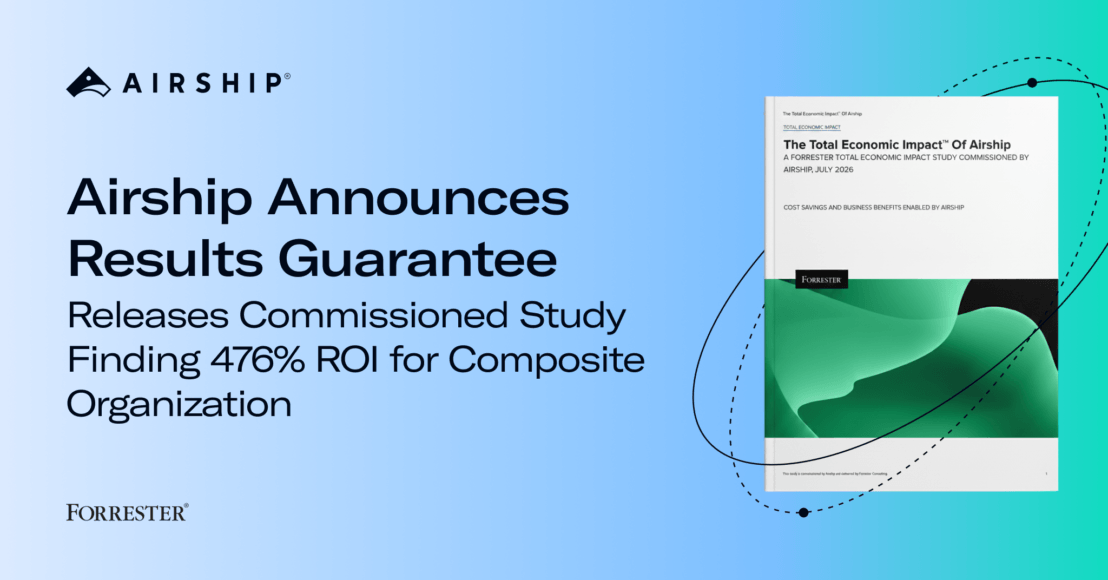
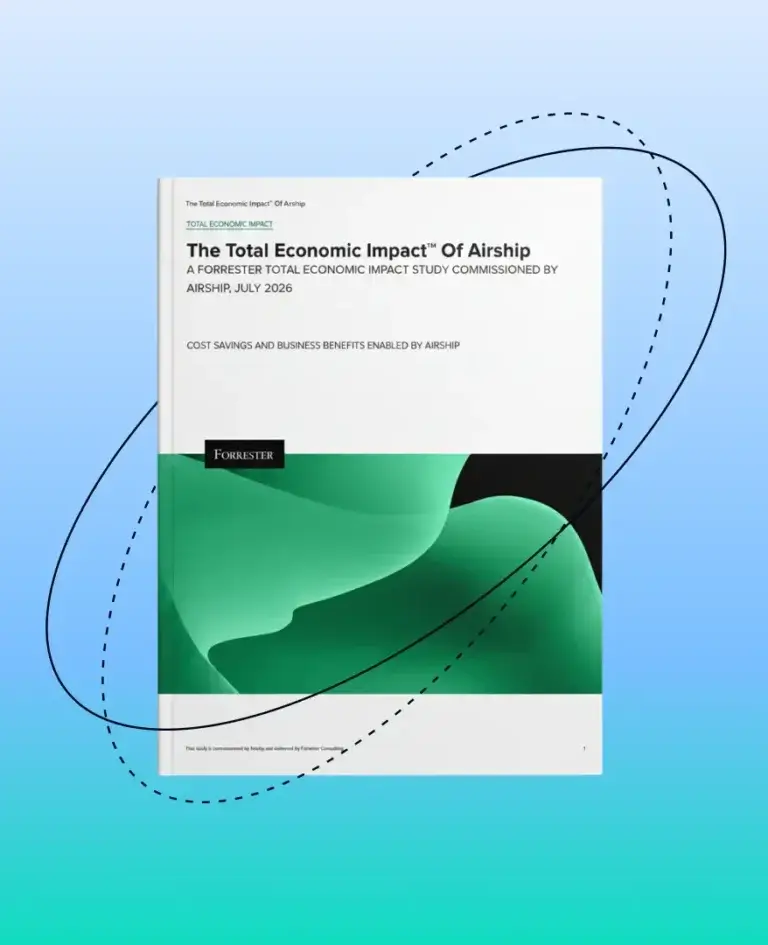
This is exactly why Airship focuses on driving real results for the world’s leading brands — measurable outcomes like revenue, retention, and customer lifetime value. This approach was evaluated in The Total Economic Impact™ of Airship, a commissioned study conducted by Forrester Consulting on behalf of Airship, July 2026.
The framework of the study was built on in-depth interviews conducted by Forrester Consulting with six enterprise Airship customers (spanning retail, logistics, hospitality, and financial services), aggregated into one composite: a global, multibillion-dollar B2C conglomerate with 10 million total customers.
Based on interviews with six real Airship enterprise customers
Forrester found significant results for customers using Airship
Forrester’s financial model designed a composite organization based on the combined experiences of six real Airship enterprise customers — a global, multibillion-dollar B2C conglomerate with 10 million total customers, 5 million of whom are digitally activated.
The baseline numbers are grounded in real enterprise scale. The model evaluated performance using a $200 annual conversion value per digital customer, an 8% purchase conversion rate, and a 12% profit margin.
Weighing total, risk-adjusted benefits against implementation costs revealed a net present value (NPV) of $6.0 million. Here is where those financial returns were realized across the composite organization.

Total Economic Impact™ of Airship: 476% ROI
The four benefit drivers
1. Elevated cross-channel CX
For the composite organization, the annual customer conversion value increased by 14% — adding an estimated $28 in value per customer by Year 3.
The framework indicates that this growth is driven by context-aware, personalized journeys and Scenes — powered by conversational AI. Instead of flooding users with irrelevant noise, the composite organization used real-time behavioral signals to deliver utility at windows of high intent. A digital experience director in the travel sector highlighted the conversion impact:
We saw higher take rates for upgraded [services] when we provided proactive, in-the-moment, triggered messaging [on-site and]; higher engagement with our large-scale sale campaigns; and broader awareness of service-related issues when we use targeted messaging [during high-impact moments]. All those metrics make a difference.

2. Expanded customer activation
The study outlined how the composite organization turned mobile apps into primary conversion destinations by refining app discovery, onboarding flows, and permission-based opt-ins.
This optimization added more than 1.8 million additional digital customers to the composite active user base. Shifting an app from a broadcast channel to an interactive destination created long-term value. One retail digital experience leader explained the connection:
Once we see you in the app and can start to engage you with push, we inevitably start to see you engage and make purchases digitally, not just in store. There’s a very clear correlation between you being engaged with [our company] both in store and digitally and your average lifetime value for those users going up.

3. Amplified marketing effectiveness
The study found that using native, no-code solutions removed development barriers entirely, letting non-technical teams deploy actual app experiences instantly.
The composite organization unlocked an 80% productivity improvement from orchestrated journeys, alongside an additional 35% efficiency boost by Year 3 via AI-driven Scenes. Teams scaled campaigns and ran safe experiments without waiting on engineering backlogs. A logistics director summarized the operational relief:
Now that we’ve built our new app and with how we put Airship into it, we probably cut marketing and development costs by 90%. … About six months ago, we basically increased our marketing ability sixfold using Airship over what we had been doing.

4. Targeted retention
Using Airship’s granular segmentation and precise cadence control, the composite organization sustained higher active usage, keeping over 314,000 at-risk customers from disengaging and lifting retention rates by 7.8% over three years for the composite organization. A communications product leader in media described the impact:
The users we retain with Airship are the users who probably would not have come back, but at least by engaging with the app, we know we are top of their mind … and they’ll continue to engage with it.

How Airship’s CX platform impacted operational effectiveness in the TEI Study
The Forrester study also highlighted critical areas where Airship changed how the composite organization ran daily operations — driving impact across the entire organization.
- Avoided service costs via in-moment guidance. Proactive, in-the-moment alerts and in-app self-service resolved customer friction points early for the composite organization. This digital resolution directly deflected call volume and lowered call center demand.
- Faster, more confident decisions at scale. For the composite organization, Airship replaced siloed metrics with shared, real-time journey data. Teams gathered data faster, reduced internal alignment loops, and pivoted roadmaps based on clear behavior signals.
- Confident innovation with built-in governance. Airship provided the composite organization the strategic guidance and platform guardrails teams needed to test ideas and experiment safely.
Costs and implementation methodology from the TEI of Airship
To maintain absolute credibility, the study balanced the $7.3 million in benefits against an explicit cost breakdown.
For the composite organization, total risk-adjusted costs over the three-year horizon equaled $1.3 million.
The primary investment broke down into $1.1 million in platform fees. This included flexible cross-channel credit consumption, dedicated professional services, and specialized AI features. The composite organization deployed Airship’s native AI experience architecture — Airship Scenes — during the first year of the investment to maximize early value.
The remaining overhead involved $127,000 dedicated to deployment and ongoing administration. Teams completed setup using a phased, four-month implementation window that required 680 cross-functional labor hours across three years. After adoption, ongoing platform management required just 312 hours per year — demonstrating that sophisticated journey orchestration did not scale internal resourcing costs for the composite organization.
Frequently asked questions about the Total Economic Impact™ Of Airship
What is a Total Economic Impact™ study?
A Forrester Total Economic Impact™ study is a commissioned analysis of a technology investment, built from customer interviews and a modeled composite organization, measuring ROI, costs, benefits, flexibility, and risk.
What did the Total Economic Impact™ find for Airship?
Forrester Total Economic Impact™ of Airship found a 476% ROI over three years, payback in under six months, and $7.3M in total benefits, quantified across six enterprise customers.
Is the Total Economic Impact™ ROI guaranteed?
No. The TEI ROI is modeled on a composite organization and varies by company size, industry, stack, and implementation. It is illustrative.
Can I compare the Total Economic Impact™ of Airship to other platforms?
No. Because each study evaluates a completely different vendor environment and models an entirely unique composite organization based on separate customer interviews, a direct comparison will not yield an accurate, apples-to-apples assessment.
What industries were analyzed for this study?
Forrester Consulting interviewed enterprise decision-makers from six real Airship customers spanning the retail, logistics, travel, financial services, communications, and hospitality sectors. These individual experiences were aggregated into a single, multibillion-dollar B2C composite organization with 10 million total customers.
What brands participated in this study?
In all Forrester TEI studies, the interviewees are anonymous. However, Forrester did speak to brands from a range of industries and regions around the world. Those interviewees include the director of digital experience at a travel company, the product leader at a communications company, the director of mobile experience at a logistics company, the head of digital banking at a financial services company, the digital experience leader at a retail company, and the media and CRM leader at a hospitality company.