Mobile-First Customer Experience for Retail & E-Commerce
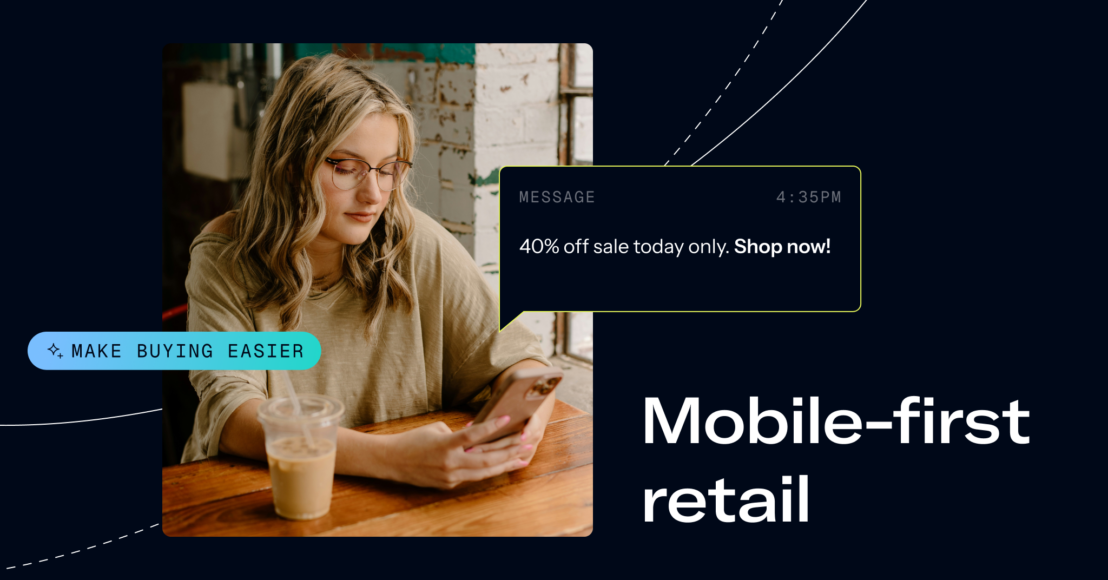
Today’s retail customers are already on mobile. More than 60% now prefer mobile when interacting with retail loyalty apps. Meanwhile, smartphones drive 78% of all global e-commerce traffic and 68% of all online shopping orders. The access retail brands have spent years trying to build — around direct, opted-in, always-on connections — is sitting right in their customers’ pockets. The problem lies in what they’re doing with it.
Most retail brands still use mobile the same way they use every other channel: sending campaigns, measuring click-through rates and open rates, and optimizing for volume. Push notifications are managed by one team, while email is handled by another, and the mobile loyalty program lives somewhere else entirely. That means each tool does its job in isolation, with no knowledge of what the others are doing. As a result, the customer on the receiving end doesn’t get a unified journey. They get a series of disconnected interruptions that train them to tune out.
That’s the gap between customer engagement and customer experience.
Engagement counts how many messages you send. Experience asks whether those messages are building something a customer would come back to. It asks whether customer interactions are actually leading to the purchases, repeat visits, and long-term value that loyalty is supposed to deliver.
Mobile is where that gap either closes or widens. It’s the most personal, persistent connection modern retail brands have to their customers’ day-to-day lives. When the mobile journey is cohesive, and channels like push, in-app and web experiences, SMS, email, and mobile wallet work together to meet a customer’s needs, it shows up in revenue and lifetime value. When it’s a patchwork of one-off messages and fragmented campaigns, it just creates more noise.
Below, we break down what the shift from customer engagement to customer experience looks like in practice for retail brands — and how leading brands are making it happen.
Learn More
Why legacy retail loyalty strategies work against themselves
Loyalty in retail has always been about repeat purchases. But, somewhere along the way, the tools used to build it started optimizing for surface-level metrics like message volume, open rates, and click-through rates. These metrics are easy to report and hard to argue with, until you look at what’s actually happening to customer value.
The issue isn’t any single tool. It’s the stack. When email, push, loyalty, and other programs live on separate platforms, each system optimizes for its own channel — which means none optimizes for the customer’s experience.
- A shopper who makes an in-store purchase on Saturday may still get an abandoned cart push notification on Sunday.
- A loyalty member browsing on desktop might receive a generic welcome message because their app profile hasn’t yet synced.
- A customer who told you their style and color preferences six months ago might still get the same standard campaign blast as everyone else.
None of these scenarios is catastrophic on its own. But, once it becomes part of a larger pattern, it trains customers to ignore you or unsubscribe completely.
At its core, this is a loyalty problem hiding in what looks like a messaging problem. The question isn’t whether your campaigns are technically “working,” but whether they’re building the sorts of relationships that compound over time — or slowly eroding the trust that makes a customer worth keeping.
What mobile-first retail experiences actually deliver
The retailers seeing measurably different results are the ones that have stopped treating mobile as a messaging channel and started treating it as the place where the customer relationship actually lives.
The evidence is substantial. According to an Airship benchmark study of more than 1,000 in-app messages across 1.7 billion device sessions, retail customers who receive mobile-first in-app experiences purchase 140% more frequently than those who don’t. That’s a structural difference in buying behavior that shows up when the app experience goes beyond notifications and becomes a destination worth returning to.
That pattern also plays out in real-world brand results.
For example, Ulta Beauty wanted a better way to personalize recommendations for their 44 million loyalty members. Their team deployed interactive in-app surveys during active browsing sessions to move beyond third-party inferences and capture color and product preferences directly from their customers. When they followed up with tailored “complete the look” push recommendations based on customers’ declared needs, the result was a 2.8x increase in purchase conversions among customers who received the personalized experience.
Our team was able to build a new and innovative experience for our guests when they were actively engaged with our app, capturing valuable insights to deliver more tailored recommendations.”

The lesson here isn’t about surveys or personalization tactics specifically, but about the principle underneath. Customers will tell you what they want if the experience makes it worth their while. And that information, collected in a high-attention mobile moment, is more accurate, more durable, and more valuable than anything you can infer from browsing behavior alone.
Other retailers are seeing similar results. Brands like Ace Hardware have seen double-digit increases in conversion rates and significantly higher engagement on abandoned cart campaigns after moving to personalized, contextually triggered mobile experiences. And Asda has reported 27% click-through rates and 40% conversion rates on abandoned cart web notifications built around real-time behavioral signals rather than just batch scheduling.
The common thread across these examples is relevance. Personalized, contextual experiences outperform generic campaigns because they’re more useful to the person receiving them. And usefulness, over volume, is what builds the kind of loyalty that actually shows up in revenue.
Three shifts that move the needle for retail teams
You don’t need to overhaul your stack to start seeing results. Three high-leverage shifts tend to pack the most punch for retail teams making the transition to customer experience.
Open rates and click-through rates are comfortable metrics. They’re easy to track, easy to report, and easy to improve in isolation. But, ultimately, they answer the wrong questions. They tell you how your campaigns are performing on their own terms, not whether your customers are growing in value.
A useful test is to look at your top three mobile KPIs. If each one doubled tomorrow, would it meaningfully increase revenue? If you’re not sure, they’re probably diagnostic metrics being treated as success metrics. The brands making the most progress on their retail loyalty app have shifted focus to metrics like purchase frequency, average order value, repeat conversion rates, and retention curves by cohort. These are indicators that connect directly to the numbers leadership actually tracks.
The gap between a helpful nudge and an unwelcome interruption is context. A push notification that fires because someone left items in their cart three days ago is a campaign. A push notification that fires because a customer just opened your app, is browsing the same category, and hasn’t completed the purchase is a relevant experience. The infrastructure required to know the difference is cross-channel orchestration. That only comes with an intelligent, unified customer experience platform that recognizes what a customer has done across all channels before deciding what to send next.
In retail, this extends to the handoff between digital and physical experiences. A customer who purchased in-store shouldn’t receive a digital campaign for the item they just bought, and a loyalty member who logs in to your app should pick up where they left off regardless of whether their last session was on mobile or desktop. These aren’t glamorous problems to solve, but they’re what makes or breaks customer trust.
Third-party behavioral data tells you what someone did, but it doesn’t tell you why or what they actually want. In retail, personalization built on behavioral inferences tends to be wrong in exactly the ways that feel most intrusive. It means assuming a customer wants to buy a winter coat because they clicked on one, when they were actually just browsing for a gift.
Zero-party data in retail — or preferences that customers share willingly because doing so makes their experience better — solves this problem at the source. Through seamless in-app experiences, you can ask customers about their size and style preferences, favorite categories, dietary restrictions, how and when they want to hear from you, and more. Customers who share that information get more relevant experiences, while brands that collect it get a personalization advantage that grows over time. That sort of edge can’t be replicated through third-party signals that are declining in both availability and accuracy.
Why the best mobile loyalty program is built between transactions
The shift from customer engagement to customer experience in retail comes down to what you’re building toward. If the goal is more messages, the tools you have are probably fine. If the goal is customers who grow in value over time — who come back on their own, trust your recommendations, and stick around when a competitor offers a lower price — then the experience has to be worth their attention.
Airship is purpose-built to help brands make that transition. We offer cross-channel orchestration that connects every interaction into a unified journey, zero-party data capture that replaces guesswork with declared preferences, and AI-powered optimization that keeps retail experiences relevant at scale — plus no-code tools that help you create and launch them quickly without developer support. Brands like Ulta Beauty, Ace Hardware, and Asda have used our platform to move past engagement metrics and toward the sort of business outcomes that actually matter.
Check out our mobile-first CX playbook to go deeper into the frameworks and tools that make it all work. Or, to see what a mobile-first customer experience strategy could look like for your brand, reach out to our team to set up a call.