Marketing personalization has always rested on a simple premise: The more a brand knows about its customers, the more relevant its messaging can be. To learn more about customers, brands have traditionally collected more data — by setting third-party cookies, trying to stitch together user identities from outside data sources, and feeding the resulting signals into algorithms to infer what each customer might want.
Today, that premise no longer holds. Cookies have all but disappeared from major browsers, permission frameworks like Apple’s App Tracking Transparency have cut visibility into user behavior, and regulatory frameworks like the GDPR and CCPA have raised the bar on what counts as legitimate consent. Perhaps most importantly, customers themselves have grown wary. According to one study, 61% of consumers now find ads based on third-party cookies “creepy,” and 64% are put off by ads that target them based on their geographic location.
In other words, inferring customer needs from the digital breadcrumbs they leave behind is increasingly less viable, less reliable, and less welcome. That raises a straightforward question: instead of trying to guess what customers want, why not just ask them directly?
That’s the idea behind zero-party data, or information that customers share deliberately and directly with the brands they trust, in return for a more tailored experience. Instead of data scraping and guesswork, it’s a win-win value exchange in which customers are largely willing participants. Research has shown that most consumers are comfortable sharing their personal data with brands, provided that their experience improves as a result.
This guide is a primer on the role zero-party data plays in modern customer experience. It covers what zero-party data is (and isn’t), how to collect and activate it, and how to measure its impact. By the end, product and growth teams should have a working understanding of where zero-party data fits in their broader customer experience (CX) strategy, as well as a clear view of what it takes to build a customer data program that delivers results.
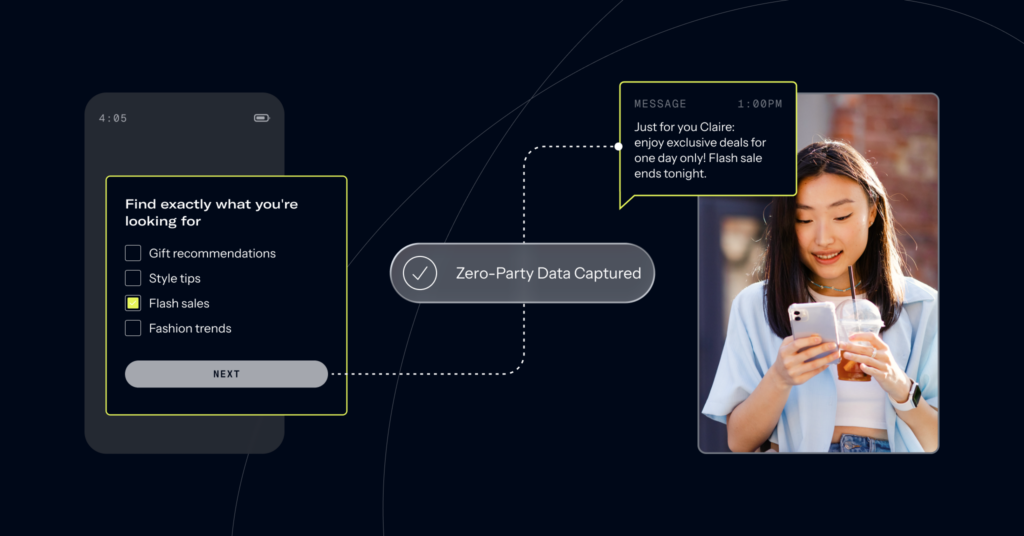
Airship’s approach to zero-party data
Airship’s CX platform is built on over a decade of mobile-first expertise, which shapes our distinct approach to zero-party data. With Airship, product and growth teams get customer data capabilities they won’t find anywhere else, including:
- Native, no-code surveys and forms designed to capture preferences in-app and on the web, when customers are most engaged
- Real-time profile updates that route customers’ stated preferences directly into segments, journeys, and campaigns without delay
- Purpose-built AI agents that treat customers’ stated preferences as their highest-quality input for smarter personalization
- A commitment to dynamic context, or the real-time combination of zero-party data and behavioral signals that allows experiences to adapt to each customer in the moment, not just over time
You can learn more about Airship’s unique approach to customer data on our platform page — or talk to our team to discuss what our data capabilities can do for your growth strategy.
What is zero-party data?
Zero-party data is information consumers share directly with a brand because they want a better customer experience. It includes everything from their product preferences and purchase intentions to their personal context and how they want to be recognized, addressed, and contacted.
As a concept, zero-party data was first established in 2020 by Forrester Research, which defined it as information that “a customer intentionally and proactively shares with a brand.” The “intentionally and proactively” part is important because, unlike other types of data, zero-party data is never inferred, purchased, or observed. It’s always voluntarily given.
The expectation is that customers share information about themselves willingly and knowingly because there’s a perceived value exchange. They tell a brand personal details and, in return, get a more relevant and personalized experience. When it works, that exchange is mutually beneficial. Brands get more powerful, higher-signal data, and customers get exactly what they’re looking for (instead of what an algorithm thinks they want).
To understand where zero-party data fits within the broader data landscape, it helps to see it situated alongside the other data types brands typically work with.
| Zero-party data | First-party data | Second-party data | Third-party data | |
|---|---|---|---|---|
Source | Shared by customers directly | Observed from customers’ actions | Shared by a partner brand | Purchased from data brokers |
Accuracy | Very high: Stated, not inferred | High: Reflects real behavior | Medium: Depends on partner quality | Low: Aggregated, often stale |
Consent | Always explicit | Implicit (behavioral) | Varies by agreement | Often unclear or absent |
Personalization value | High: Customers tell you exactly what they want | Strong: Reveals behavioral patterns over time | Moderate: Adds reach, but with less depth | Low: Broad and non-specific |
Privacy risk | Low | Low (with consent) | Medium | High |
Zero-party data is the only data type that combines very high accuracy and fully explicit consent with a low privacy risk. Second- and third-party data carry meaningful tradeoffs across each of those categories, which can make them costly to rely on.
The most meaningful comparison is between zero-party and first-party data. They’re often considered side by side, and for good reason — together, they form the foundation of a modern, privacy-compliant customer data strategy.
How does zero-party data compare to first-party data?
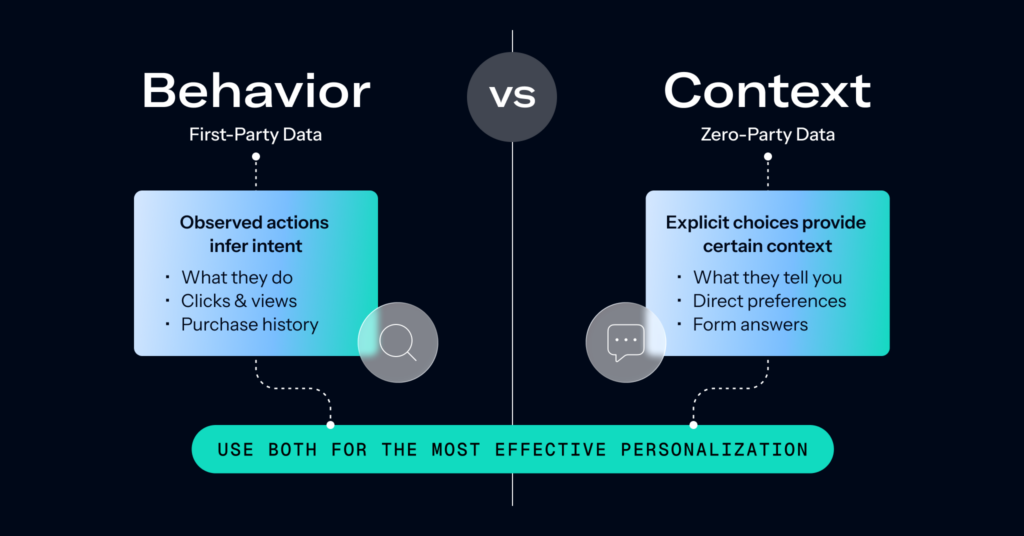
Zero-party data and first-party data differ in how they’re collected and what they reveal.
First-party data is behavioral. It’s what brands observe about customers from their actions, including:
- Pages they view
- Products they click on
- Emails they open
- Purchase histories
- Time they spend in apps and on websites
This data can be valuable because it’s collected directly by the brand, rather than purchased from an outside source. However, it’s inferential. A brand still has to interpret what a series of behaviors means to determine what a customer actually wants.
Zero-party data is declarative. Instead of inferring preferences from customer behavior, brands hear about them directly. For example, a customer who selects “running” as their primary sport in an onboarding form has told the brand something their purchase history alone might not reveal for months. A subscriber who sets their notification frequency preference to “no more than twice a week” has answered a question that no algorithm can confidently settle.
The distinction matters because personalization built on inference can misfire. Behavioral data captures what customers have already done, but not necessarily what they’d like to do next or what they care most about. Zero-party data fills those gaps directly and accurately.
In practice, however, the strongest customer profiles combine these two data types. First-party data reveals behavioral patterns over time, while zero-party data provides the context that makes those patterns interpretable. Brands that rely on one without the other are either guessing at the “why” behind customer actions or collecting preferences they can’t yet connect to meaningful outcomes.
When to lean on first-party and zero-party data:
Use first-party data to understand what customers are doing and identify important behavioral patterns. Use zero-party data to understand why they’re doing it and what they’d like to happen next. Use first-party and zero-party data together to build the kind of customer profile that makes personalization feel less like targeting and more like a meaningful relationship — the kind in which the brand actually remembers and acts on what the customer has shared.
Why is zero-party data important?
The case for zero-party data has grown alongside the erosion of the data infrastructure brands have spent the last decade building. Three shifts in particular have made pursuing it more urgent.
1. The collapse of third-party data
For years, brands were able to supplement the customer data they collected themselves with data purchased from outside sources. That included behavioral signals from tracking pixels, data brokers, and third-party cookies.
However, that infrastructure is now unraveling. Web browsers like Safari and Firefox blocked third-party cookies years ago. Google’s move toward a post-cookie web has been slower than expected but is still very much underway. And Apple’s App Tracking Transparency framework, introduced in 2021, has since required apps to request explicit permission before tracking users across other apps and websites — and most users have said no.
The regulatory environment has only accelerated this shift. The GDPR in Europe, CCPA in California, and a growing body of similar privacy laws around the world have raised the bar for what counts as legitimate user consent. Brands that once relied on broad, buried consent language to justify their data collection practices now face real enforcement risk if they don’t adapt.
The result is that brands have less access to third-party data than they did five years ago, and what they do have is of lower quality. Paid acquisition costs have also risen as targeting precision has dropped, since reaching the right customer via paid channels costs more when you know less about who you’re aiming for.
2. The need for personalization
At the same time, customer expectations around personalized experiences have continued to rise. Today, generic messages convert at a fraction of the rate of tailored experiences that reflect what an individual actually cares about. Customers notice when a brand “gets” them, but they also notice when a brand clearly does not.
True personalization requires knowing what customers want instead of just what they’ve done. Purchase history tells you what they bought last quarter, but stated preferences can tell you what they’re looking for right now. That difference becomes significant for any brand trying to move customers from a one-time purchase to a loyal, ongoing relationship.
The other half of the equation is speed. Customers who share their preferences expect to see them reflected right away. When a brand collects zero-party data and acts on it in real time (within the same session or the next interaction), the value exchange becomes tangible. That immediacy is what transforms a zero-party data program into a loyalty driver. Customers see the benefit, trust the brand with more, and stay engaged longer. When activation lags, the value exchange breaks down, even if the underlying data is strong.
3. Privacy as a competitive advantage
Increasingly, the way brands collect and handle customer data is itself a differentiator, especially as customers grow more aware of their data rights and privacy concerns. A recent Pew Research study found that 81% of U.S. adults are “concerned” about how companies use their personal data, and 67% report having “little to no understanding” about what companies do with the data they collect.
Brands that treat data collection as a transparent exchange rather than a covert operation have the potential to build customer trust in ways their less principled competitors cannot.
Zero-party data is inherently consent-based. When a customer shares their preferences, they’re doing it knowingly, in exchange for something they perceive as valuable. That changes the dynamic of the relationship, and it makes compliance with privacy regulations significantly easier. There’s no ambiguity about where the data came from or whether the customer knew they were providing it.
How is zero-party data used?
Zero-party data covers a broad range of information customers might share, including everything from style preferences to how often they want to hear from their favorite brands. It generally falls into five categories:
- Preference data: A customer’s product interests, category preferences, style or aesthetic choices, and frequency appetite — all the things customers care most about within a brand’s universe
- Intent data: Wish lists, planned purchases, shopping occasions, and upcoming life events. This is some of the highest-value data a brand can collect because it reflects what’s happening for a customer at any given moment, rather than what they’ve done historically.
- Personal context: A customer’s life stage, household composition, geographic location, common use cases, and other demographic and situational information that shapes what “relevant” means
- Feedback and sentiment: Satisfaction scores, product ratings, open-ended survey responses, and other data that helps brands understand how customers feel about what they’re getting, in addition to what they’re looking for
- Communication preferences: Preferred channels (e.g., push, email, SMS), cadence, and time of day. Getting this piece right improves response rates, reduces unsubscribes, and builds the kind of trust that keeps customers opted in over time.
In practice, these categories translate into very different customer experiences depending on the industry. The underlying logic is the same, but the specific details a brand collects and the experiences those details unlock are shaped by what its customers are trying to achieve.
- In retail, zero-party data might mean a customer selecting their eye color in a quiz, telling the brand which beauty categories they’re most interested in, and indicating that they prefer to hear about new product arrivals rather than promotional pricing. Each of those data points enables a different kind of personalized experience.
- In travel and hospitality, it might look like a loyalty program member indicating their preferred seat type, the destinations on their bucket list, and whether they typically travel for business or leisure. That context can transform a generic email or text message into something that feels like it was written just for them — and surface the sort of vacation offers they actually want to act on.
- In media and entertainment, zero-party data may look like a subscriber selecting the content categories they want to follow and setting their preferred frequency for notifications and alerts. The result is a feed that feels carefully curated and engaging rather than algorithmic.
Across each industry, a relatively small, low-friction customer ask can unlock a meaningfully more relevant experience. When that value exchange is designed well, customers don’t experience it as data collection, but as a brand paying attention to their individual needs.
What are the business benefits of zero-party data?
Brands that get zero-party data right tend to outperform their peers on the metrics that matter most: conversions, average order value (AOV), retention, and customer trust. Here’s what each related outcome looks like in practice.
Higher accuracy in personalization
Personalization built on stated preferences is both more accurate and more trusted than personalization built on behavioral inference and guesswork. When a customer tells you what they want, the experience you build around that information feels like thoughtful attentiveness, rather than surveillance or targeting.
Stronger customer relationships and loyalty
The act of clearly and transparently asking customers what they want, with an obvious value exchange, signals that a brand sees customers as individuals rather than data points. Customers who share their preferences also tend to be more engaged and more loyal over time, since the act of sharing itself increases their investment in the relationship.
Reduced reliance on paid acquisition
Brands with in-depth zero-party data profiles can do more with owned channels (like push, email, SMS, and in-app messaging) and rely less on paid retargeting. Owned channel conversions cost less than their paid media equivalents, and they compound over time as customer profiles become more complete. Brands that have built deep zero-party data stores are in effect reducing their customer acquisition cost at scale.
Better AI outcomes
AI-driven personalization is only as good as the data that goes into it. Zero-party data offers a much more direct signal for recommendation engines, customer journey optimization tools, and predictive modeling. As AI becomes more central to the way brands operate, the quality of the data feeding it will become a significant competitive differentiator.
Privacy compliance by design
Zero-party data is inherently consent-based, as customers share it deliberately and in a context where the exchange is transparent. That makes it far easier to manage from a compliance standpoint than inferred or purchased data and creates a more defensible asset. If a customer submits a data subject access request or asks to have their information deleted, the chain of custody for zero-party data is easily auditable.
Improved opt-in rates and channel growth
Customers who see their preferences being applied in practice are more likely to opt into additional channels and stay opted in over time. Preference capture during onboarding, when done well, sets the tone for the entire customer relationship. It signals that the brand intends to use what it learns and that opting in will mean something real. The downstream effect is a boost in opt-in rates, email opens, push notification response rates, and long-term retention.
Higher conversion rates and purchase lift
This is where the impact of zero-party data is easiest to measure and hardest to dispute. When campaigns draw on stated preferences rather than inferred behavior, they resonate more, and that resonance shows up directly in conversion and purchase rates.
Across Airship’s customer base, brands that have used zero-party data to power audience targeting have seen lifts in push purchase attribution, conversion rates, and AOV. These aren’t marginal improvements, but the kind of results that can change how a marketing team plans its next quarter.
How do CX platforms collect zero-party data?
CX platforms collect zero-party data by creating deliberate moments of exchange through in-app surveys, preference prompts, onboarding flows, and other interactive experiences that give customers a clear reason to share. Unlike passive data collection, which infers customer preferences from their behavior, zero-party data collection is opt-in by design, typically faster to accumulate, and (when done right) something that customers actually enjoy participating in.
But “done right” matters more here than in many other data contexts. Customers are happy to share zero-party data when there’s a clear reason to, the exchange feels fair, and they trust that the brand will actually put it to use. Brands that miss any of those conditions get lower response rates and potentially damage the customer relationship they were trying to build.
Where data is collected matters just as much as how. For Airship customers, in-session experiences (like surveys, polls, and preference prompts, surfaced while customers are already engaged) consistently outperform other channels by a wide margin, with conversion rates up to 8x those of push notifications alone — especially when paired with gamification. The reason is simple: if you ask while the customer is actively paying attention, they’re far more likely to answer.
Collection channels and formats
- Mobile in-app surveys and polls
- Web in-session messages and preference prompts
- Onboarding flows with preference capture
- Email and SMS preference centers
- Gamified experiences, quizzes, and configurators
- Wishlist and favorites functionality
No-code collection at scale
One of the more significant practical barriers to zero-party data collection has historically been the technical lift required to build surveys, quizzes, in-app messages, and other capture methods. Launching a custom in-app quiz typically required developer resources, lengthy design cycles, and QA processes, limiting how often brands could run them and how quickly they could iterate.
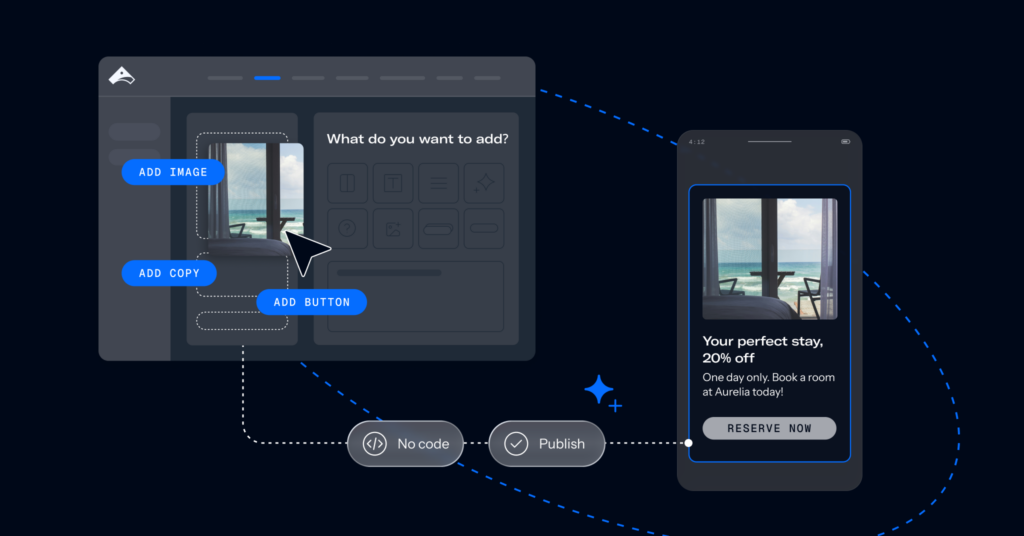
CX platforms like Airship have changed that, with no-code tools that allow product and growth teams to build, launch, and adjust in-app surveys and preference capture experiences without any engineering support. These tools reduce both the cost and the time-to-launch for zero-party data programs, so what once required an expensive sprint can now be done in an afternoon.
Inside look: Airship Surveys
Airship Surveys are designed to get richer customer data more efficiently, directly within the app or web experience.
With branching logic, surveys adapt in real time based on what each customer says, asking the next most relevant question rather than cycling through a generic list.Every response is stored immediately as an attribute on the customer record and made available for personalization without any additional sync or data transfer. Because everything runs through a visual editor that product and marketing teams control, there’s no dependency on developers, no need to coordinate across platforms, and no lag between what a customer shares and what your campaigns can use.
You can also A/B test different survey flows and layouts so that, over time, you’re not just collecting more data, but finding the fastest, most frictionless path to it.
Proof in practice: Ulta Beauty
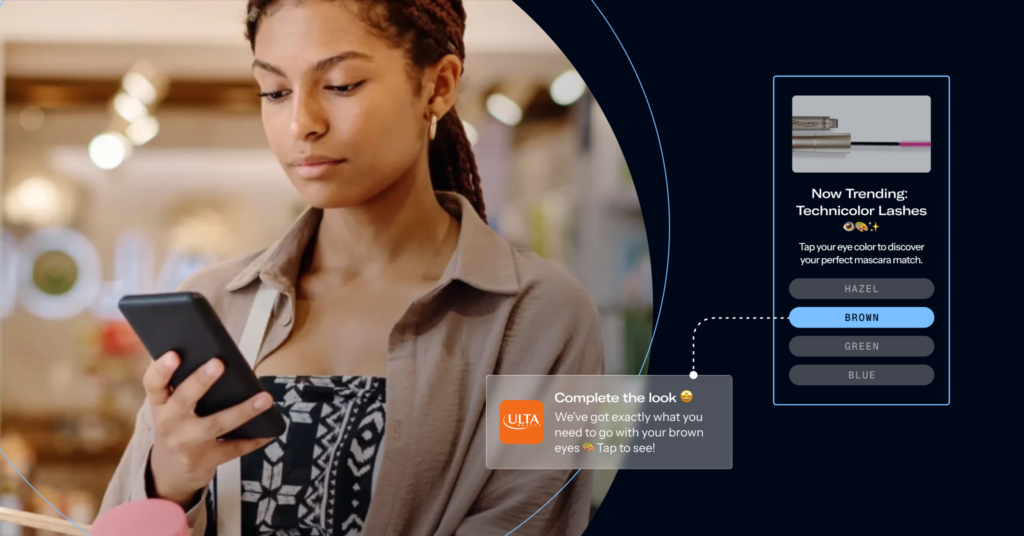
Ulta Beauty is the largest specialty beauty retailer in the United States, with more than 44 million loyalty members. With Airship, they deployed a custom in-app survey to capture preferences from customers exploring a colored mascara trend. They built the entire experience directly in the app, without developer support, asking customers to select their eye color so the brand could recommend the right shades.
The results were significant, with over 828,000 preferences gathered, a 7% cumulative response rate, and purchase conversion rates 2.8x higher among customers exposed to the in-app survey.
“We are continually looking for new ways to leverage data and insights from our more than 44 million loyalty members to better understand their unique needs and preferences and adapt our strategies to deepen and grow guest engagement and loyalty. With Airship, our team was able to build a new and innovative experience for our guests when they were actively engaged with our app, capturing valuable insights to deliver more tailored recommendations.” – Jodi Williams, VP of Ecommerce at Ulta Beauty
Is zero-party data secure?
Enterprise buyers, especially in regulated industries, reasonably ask about the security implications of collecting and storing customer preference data. Zero-party data is high-signal and deeply personal. When customers share it deliberately, a breach or misuse carries a higher trust cost. That makes security essential for both compliance and relationship health.
Data minimization and purpose limitation
Data minimization means collecting only what you’ll actually use. Zero-party data programs that gather more data than they can activate create unnecessary friction and storage risk and often fail to deliver value for both the brand and the customer. Customers share their preferences for a reason. If those preferences never surface in their experience, the implicit promise behind the exchange is broken.
Consent management and auditability
Zero-party data should be explicit, granular, and logged. Customers should be able to see and update the preferences they’ve shared and revoke consent at any time. Preference centers are the mechanism through which brands demonstrate they’re treating customer data responsibly. It’s worth noting that audit trails for collection events are increasingly expected by enterprise procurement and legal teams as part of vendor due diligence.
Storage, access, and data residency
Where preference data is stored matters, particularly for brands operating across jurisdictions with conflicting data residency requirements. The EU, for example, has specific rules around where data on European citizens can be held and processed. Brands should verify that any platform they use for zero-party data collection can meet their specific residency requirements.
Security advantages of zero-party data
There’s an underappreciated security argument for zero-party data over third-party data, which is the chain of custody. Third-party data arrives with an unknown provenance, since a brand often cannot say with certainty how that data was collected, under what consent framework, or whether that consent was valid under current regulations. Zero-party data, on the other hand, is fully traceable. A brand collects it directly, at a specific time, in a specific context, and with explicit customer knowledge and consent. That traceability makes it significantly easier to defend in a regulatory audit or to respond to a data subject access request.
Evaluating zero-party data platforms
For teams evaluating a CX platform’s approach to zero-party data collection, the questions worth asking extend well beyond the features. Security, compliance, and customer rights are the areas where providers meaningfully diverge, and it’s where their answers either reinforce confidence or expose risk.
Questions worth raising in any vendor assessment include:
- Where is customer data stored, and does it meet our specific data residency requirements?
- How is consent logged and surfaced for audit purposes?
- What access controls exist for preference data, and how are they managed?
- How does your platform handle data subject rights requests (specifically around data access, deletion, and correction)?
- What security certifications do you hold (for example, SOC 2 Type II or ISO 27001)?
To see how Airship handles customer data and review our certifications and compliance frameworks, visit our Trust Center.
How do you build an effective zero-party data strategy?
The brands that get the most out of zero-party data collection don’t treat it as a campaign, but as an ongoing program — one that deepens over time as customer relationships mature and customer data profiles grow more complete.
The importance of data freshness
A customer who indicated they prefer casual styles last year may now have a different job, lifestyle, or taste. A traveler who once said they prefer the aisle seat may now travel with kids and prefer the window. Zero-party data that sits static in a profile without being refreshed becomes a liability more than an asset. Personalization built on outdated preferences can feel as bad as or worse than no personalization at all.
The best zero-party data programs build in mechanisms for preference updates, including periodic check-ins, event-triggered surveys, and preference centers that make it easy for customers to update their information. In retail, travel, and media especially, where preferences can shift by season, occasion, and life event, the recency of preference data is just as important as its completeness.
Integration as a multiplier
A brand that collects rich preference data but can’t connect it to marketing campaign logic, recommendation engines, or journey orchestration has built a data archive, not a personalization program. The unlock is integration, which is data flowing in real time into the platforms that actually shape the customer experience. Today, that often means CRMs, marketing automation tools, and AI-driven agents.
This is where many zero-party data programs quietly stall out, as the collection itself works, but the activation does not. Brands end up with rich preference data sitting in a customer data platform (CDP), while the campaign tools that could use it sit in another system altogether. The strategies that do succeed are the ones where preference data flows in real time to the systems that actually decide what the customer sees next.
Inside look: Integration
The most common stall in a zero-party data program isn’t collection, but activation. Brands often have the data but haven’t connected it to the tools that shape what customers actually see next.
A few integration approaches make the biggest difference. For brands that aren’t storing data in Airship yet, or whose integrations aren’t fully set up, External Data Feeds allow real-time personalization using a webhook that pulls in your latest data at the time of send, so the content is always current without requiring migration. For teams working with a data warehouse, Zero Copy Data enables real-time segmentation and message personalization against data you already own, without duplicating it.
Custom events are another powerful activation layer. By triggering journeys based on specific behaviors (like an abandoned cart) and including contextual properties with those events, you can automate highly relevant follow-ups at exactly the right moment. Preference centers do double duty, capturing messaging preferences that help customers opt down rather than out, while simultaneously expanding the channels through which you can reach them.
The five strategic pillars
- Design for true value exchange. Customers share preferences when they get something in return. That something needs to be immediate and obvious, like a better product recommendation, a more relevant offer, or another experience that clearly reflects what they just told the brand. Think, “Tell us your favorite categories, and we’ll pull up our latest related products,” rather than a generic, “Help us serve you better.”
- Build profiles progressively. Asking customers everything at once creates friction and drives down response rates. The most effective zero-party data programs collect data incrementally, starting with the highest-leverage data points (like the preferences most likely to improve the next experience) and layering in more over time as the relationship deepens. A new customer who selects two or three preferences at onboarding brings in significantly more value than one who starts but abandons a ten-field form.
- Choose the right moment, in the right place. Zero-party data collection works best when customers are engaged. An in-app survey presented to a customer who is actively browsing will typically outperform an email survey sent to the same customer the following week. In other words, the context has a big impact on the quality and completeness of the response. Mobile app users, in particular, are already actively engaging with a brand when in-session, which is why in-app data collection consistently outperforms other channels on response rate.
- Activate quickly. The faster a brand acts on what a customer shares, the more reinforcing the exchange becomes. Use their stated preferences to personalize the very next customer interaction instead of the next quarterly campaign. Customers who see their preferences reflected immediately are more likely to share again, update their preferences over time, and stay opted in to the channels where it all happens.
- Close the loop. Customers stop sharing information when they see no evidence of it making a difference. Show them that what they’ve shared is actually being used. Brands that visibly act on stated preferences — by surfacing relevant products, adjusting notification frequency, or personalizing subsequent campaigns — reinforce sharing behavior and build the trust that drives future engagement.
Common pitfalls to avoid
- Collecting preference data and not acting on it: This is the most common mistake teams make in a zero-party data strategy, and it can quickly erode customer trust.
- Collecting too much data at once: Form fatigue reduces response quality and signals to customers that the collection process is more about the brand than it is about them.
- Treating zero-party data as a marketing effort rather than a cross-organizational initiative: Preference data is only as useful as the systems and teams that can access it. Product, growth, marketing, and other teams all need to be aligned on how it’s collected, stored, and used.
- Letting the data grow stale: Preferences collected once at onboarding and never refreshed become less useful over time.
How do you measure the impact of zero-party data?
Zero-party data is an input, not an output. That means it doesn’t show up in standard attribution models the way a click or a conversion does. The right approach is to measure the downstream outcomes that preference data enables and to build the cohort structure that makes those outcomes legible.
Metrics that matter here include:
- Preference capture rate: The percentage of active users who have at least one zero-party data point on file. This is the baseline metric that everything else builds on.
- Profile completeness score: The depth of preference data per user. A customer with one captured preference is more valuable than one without any, but a customer with five is more valuable still. Tracking completeness over time shows whether your data collection program is working.
- Personalized message engagement lift: The performance difference between personalized messages drawing from stated preferences vs. non-personalized messages sent to comparable segments. This is the clearest signal of preference data’s direct value.
- Average order value delta: The difference in AOV between customers who received personalized experiences and those who didn’t.
- Repeat purchase rate: The purchase frequency of customers whose preferences have been captured, compared to those without captured preferences. This is one of the cleanest ways to quantify the loyalty impact of zero-party data.
- Opt-in rate improvement: How often customers who have shared data opt into owned channels, compared to those who have not. Tracking this trend alongside preference capture milestones can reveal the channel growth impact of a zero-party data program.
A note on cohort analysis
The most illuminating analysis compares two cohorts: customers with at least one zero-party data point on file, versus customers without. This comparison, tracked over 30-, 60-, and 90-day windows, typically reveals meaningful differences in engagement, conversion, repeat purchases, and AOV. It’s also the cleanest way to make an internal business case for expanding a zero-party data program.
How does Airship handle zero-party data?
Airship is the CX platform purpose-built around the conviction that mobile is where the most valuable customer relationships are created — and that those relationships depend on knowing what customers actually want, instead of just what they’ve clicked on.
That conviction is embedded in the way Airship approaches zero-party data. Every tool in the platform is designed to help brands collect, activate, and measure preference data at scale, without requiring engineering resources or long development cycles.
- No-code surveys and forms for app and web: Airship’s native survey and form builder empowers product and growth teams to design, launch, and iterate on preference capture experiences without developer support. In-session surveys, preference prompts, onboarding flows, and interactive content can be built and deployed in a matter of hours — a speed to launch that matters when preference windows are tied to moments of customer attention.
- Real-time profile updates: Preferences captured through Airship update customer profiles in real time, making them immediately available to segments, journeys, and AI agents. There’s no delay between what a customer tells the brand and what the brand can do with it. For personalization to feel meaningful, that lag has to be close to zero — and, with Airship, it is.
- Purpose-built AI Agent Fleet: Airship’s AI Agent Fleet (including the Recommendations Agent, Campaigns Agent, Journeys Agent, and Native Experience Agent) is designed to use zero-party data as the highest-quality input. Stated preferences are a cleaner signal than behavioral data for AI-driven personalization, as they require no inference, carry no ambiguity, and reflect what customers really want. Brands that combine rich zero-party data profiles with Airship’s AI Agent Fleet can deliver personalization that feels attentive rather than algorithmically generated.
- Mobile expertise that makes collection simpler: Airship’s depth in mobile, built over a decade-plus of working with the world’s leading app-first brands, informs how zero-party data tools are designed. In-app collection produces higher response rates than email-based preference surveys, and in-session timing produces higher quality responses than out-of-context prompts. Airship’s platform is built around those realities, because mobile is where customer attention is, and it’s where the highest-signal preference data originates.
- A focus on measurable results: Airship is obsessed with real business outcomes rather than just features or vanity metrics. The brands that use Airship’s zero-party data tools see results in the metrics that matter, including preference capture rate, AOV lift, repeat purchase rate, and push opt-in growth. Airship’s customer success teams work alongside brands to make sure the data being collected is actually driving those numbers.
Collect and activate zero-party data with Airship
Zero-party data FAQs
What is the definition of zero-party data?
Zero-party data is information that customers purposely and proactively share with a brand, including their preferences, intentions, and personal context. Unlike other types of customer data, it isn’t inferred from behavior or purchased from an outside source; it’s voluntarily offered in exchange for a more relevant customer experience. The term was first defined by Forrester Research in 2020.
What is the difference between zero-party data and other types of data?
Zero-party data is the only customer data type explicitly provided by customers themselves. First-party data is observed from a customer’s actions on a brand’s own properties. Second-party data is shared between partner brands, and third-party data is purchased from outside data brokers. That distinction makes zero-party data the most accurate, consent-aligned, and lowest-risk option from a data privacy standpoint, which is why it has become an increasingly important foundation for personalization as third-party data sources decline.
What are the best ways to collect zero-party data?
Brands typically collect zero-party data through in-app surveys, web in-session messages, preference centers, onboarding flows, gamified experiences like quizzes and configurators, and social media polls. The most effective methods pair collection with a clear value exchange (like a more relevant recommendation, a personalized offer, or a curated feed), so customers see an immediate benefit for sharing. In-app collection strategies, which use moments when customers are already fully engaged, consistently outperform email-based surveys when it comes to response rates.
What are some examples of zero-party data?
Common examples include a retail customer selecting their style preferences in an onboarding quiz, a streaming subscriber choosing their favorite content categories, a traveler indicating their preferred airline seat or hotel room type, and an app user setting their preferred notification frequency. Each example involves information the customer has actively chosen to share, typically because doing so improves their overall experience with the brand.
Is zero-party data GDPR compliant?
Zero-party data is one of the most GDPR-aligned types of customer data because it’s collected with explicit, informed consent. Customers know exactly what they’re sharing and why, which directly satisfies the consent and transparency standards that GDPR was designed to enforce. Brands still need to follow standard requirements around storage, access controls, and the right to erasure, but the consent layer is built into the zero-party data collection process.
Why are brands focused on zero-party data now?
Three shifts have made zero-party data essential to modern customer experience. Third-party cookies and cross-app tracking have largely disappeared, customer expectations for both personalized experiences and data privacy have continued to rise, and data protections like the GDPR and CCPA have raised the bar on consent. Zero-party data addresses all three at once, because it’s consent-based, customer-provided, and high-signal.
Can zero-party data improve marketing performance?
Yes, often significantly. In Airship’s experience, brands using zero-party data to power audience targeting have seen lifts as high as 91% in purchases attributed to push notifications, and brands using in-session preference capture have seen AOV increases of up to 38%. The accuracy of stated preferences makes zero-party data a higher-quality input for both human-led campaigns and AI-driven personalization than behavioral data alone.