Data availability depends on your Performance Analytics plan.
## Navigation To access to the Explore: 1. Go to **Reports**, then **Performance Analytics**. 1. Select the folder icon ( ), then **Shared**. 1. Under **Looks**, select **Explore Glossary** (**Explore Glossary EUCS** for EU customers). 1. Select **Engagement**, then **Navigate to Explore**.For a list of all Explores in the glossary, see Predefined Explores in Exploring Performance Analytics data.
## Field categoriesThe sidebar lists categories for various filters, [Dimensions](https://www.airship.com/docs/reference/glossary/#pa_dimension), and [Measures](https://www.airship.com/docs/reference/glossary/#pa_measure) you can use to explore your data. To see their definitions, hover over an item, then select the “i” icon ( ).
Field categories in the Engagement Explore:| Category | Description |
|---|---|
| A/B Testing | Get data about each variant of an A/B Test. |
| Attributes Current | Get Attribute values associated with the channels at the time the report is run. |
| Attributes Relative | Get Attribute values associated with the channels at the time push notification or Message Center message was sent or when the in-app message was displayed. |
| Device Properties Current | Get device property values associated with the channels at the time the report is run. |
| Device Properties Relative | Get device property values associated with the channels at the time push notification or Message Center message was sent or when the in-app message was displayed. |
| In-App Automation | Get configuration details about In-App Automations and Scenes, such as priority, dates, and display type (layout/format). |
| Message Content | Get the message text and additional details, such as notification ID, title, etc. In the Dimension and Measure names, Journey means [Sequence](https://www.airship.com/docs/reference/glossary/#sequence). |
| Message Delivery | Get data about sends, such as dates, rates, and counts. SMS includes the Dimension SMS Deliveries — Is RCS (Yes / No) and the Measure RCS Read Count. |
| Message Metrics | Get performance data, such as response and click rates, including bounce data for email. |
| Query Parameters | Target all or specific projects, and specify dates and response windows, where relevant. |
| Response - Custom Events | Get metrics for Custom Events associated with App direct and indirect opens. |
| Response - Custom Event Window | Get metrics for Custom Events associated with App direct and indirect opens that occurred within one hour of send time. To set a new time window, go to Query Parameters in the sidebar, then select the Response Window filter and configure the filter. Fractions of an hour are accepted. |
| Response - Custom Event Window - Time-only | Get metrics for Custom Events, regardless of attribution, that occurred within one hour of send time. To set a new time window, go to Query Parameters in the sidebar, then select the Response Window filter and configure the filter. Fractions of an hour are accepted. |
| Response - Custom Interaction Events | Get metrics for Custom Events associated with an interaction_id. |
| Response - Events Times | Get metrics for App direct and indirect opens that occurred within a specific number of minutes after send time. To set a new time window, go to Query Parameters in the sidebar, then select the Response Window filter and configure the filter. Fractions of an hour are accepted. |
| Response - Tag Changes | Get Tag change events that occurred within one hour of send time. To set a new time window, go to Query Parameters in the sidebar, then select the Response Window filter and configure the filter. Fractions of an hour are accepted. |
| Tags Current | Get Tag values associated with the channels at the time the report is run. |
| Tags Relative | Get Tag values associated with the channels at the time push notification or Message Center message was sent or when the in-app message was displayed. |
| Timeframe Comparison | Compare data in Measures for the most recent and prior time frames. Specify time frames in a number of days. |
| User Detail | Get information about the channel that performed the filtered event. |
| User Detail - Derived | Get historical information about the channel that performed the filtered event. |
Use filters to reduce the number of records scanned and results returned. Each Explore includes filters that cannot be removed from the query.
The filter name, [field category](#field-categories), and usage information for the default filters in the Engagement Explore:| Filter name | Field category | Use the filter to... |
|---|---|---|
| Message Type Filter | Message Delivery | Return results for a specific message type. Default selection: Push Notification. Other possible selections: Message Center, In-App Impression1, Web Notification, SMS notification, Email Notification, or Multiple. By default, Multiple returns results for all message types, which can result in longer processing time. Add the Message Type Sub Filter so you can specify individual message types. After selecting Multiple:
|
| Current Project Only | Query Parameters |
Determine which projects are included in the query. Default selection: Yes. To include other projects within your company, select No, then:
|
| Date Range | Query Parameters | Target events that occurred on a specific date or within a specific date range. |
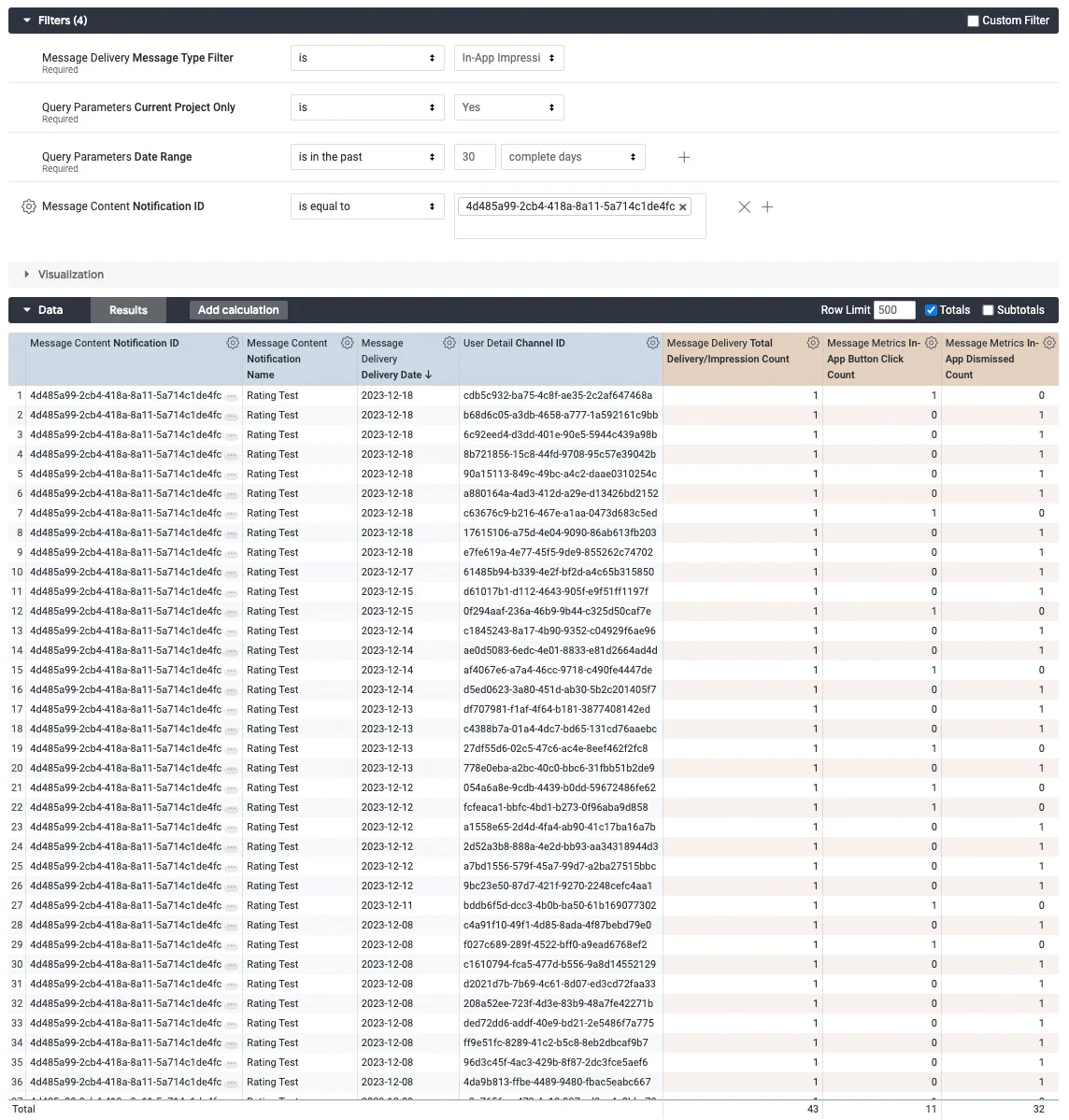
Now you are ready to get your data. Select Run, and you should see results similar to the below image. To save your custom query for later access, follow the steps in Saving Performance Analytics queries.
 *Creating a custom query from the Engagement Explore* ### Push notifications Follow these steps to get the number of push notifications delivered over the past 30 days. We'll use the default filters and add a filter for platform to get only data for iOS and Android. First, [open the Engagement explore](#navigation), and then configure your query: 1. Set up the filters: 1. Leave **Message Type Filter** and **Current Project Only** set to their defaults `is Push Notification` and `is Yes`. 1. Set **Date Range** to `is in the last 30 complete days`. 1. In the sidebar, select **User Detail**, then **Platform Filter**. > **Tip:** Instead of navigating to filters, Dimensions, and Measures, you can find them using the search box at the top of the sidebar. 1. Leave **Platform Filter** set to `is equal to`, and then select the entry field and select `ANDROID` and `IOS` from the list. 1. 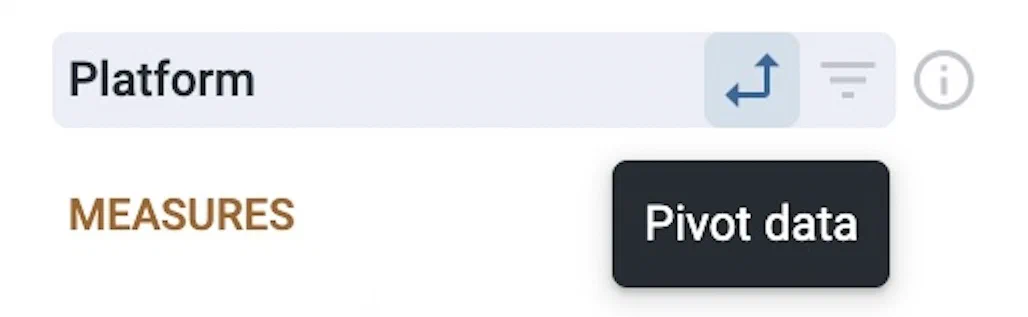 *Selecting the option to pivot data* In the sidebar, specify values to display: 1. Select **Message Delivery**, then select the Dimensions category **Delivery Date**, then **Date**. 1. Select **User Detail**, select the Dimension **Platform**, then select the double-arrow icon next to **Platform**. The pivot option adds detailed metrics for each platform and makes it more readable. It can be helpful when using the Graph visualization. 1. In the sidebar, add measurements to display: 1. Select **Message Delivery**, then select the Measures category **All Deliveries/Impressions**, then **Total Delivery/Impression Count**. 1. Select **Message Metrics**, then select the Measures category **Push Metrics**, then **Attributed Open Count**. Now you are ready to get your data. Select **Run**, and you should see results similar to the image below. 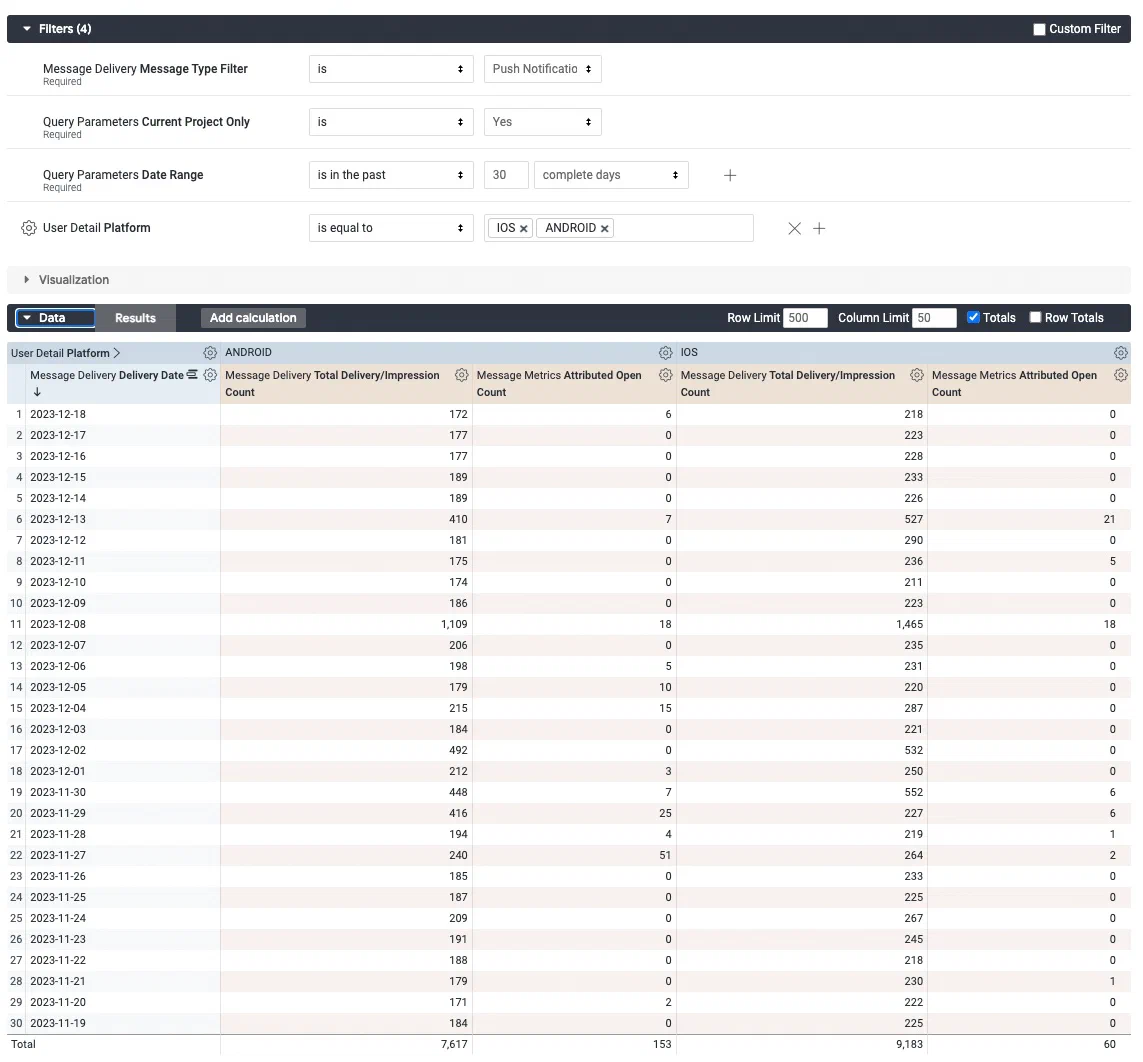 *Creating a custom query from the Engagement Explore* Next, select the down arrow icon ( ) next to **Visualization** and select the column icon ( ). Use this format to look for obvious gaps or other changes to help you identify if something is going wrong with your push delivery: 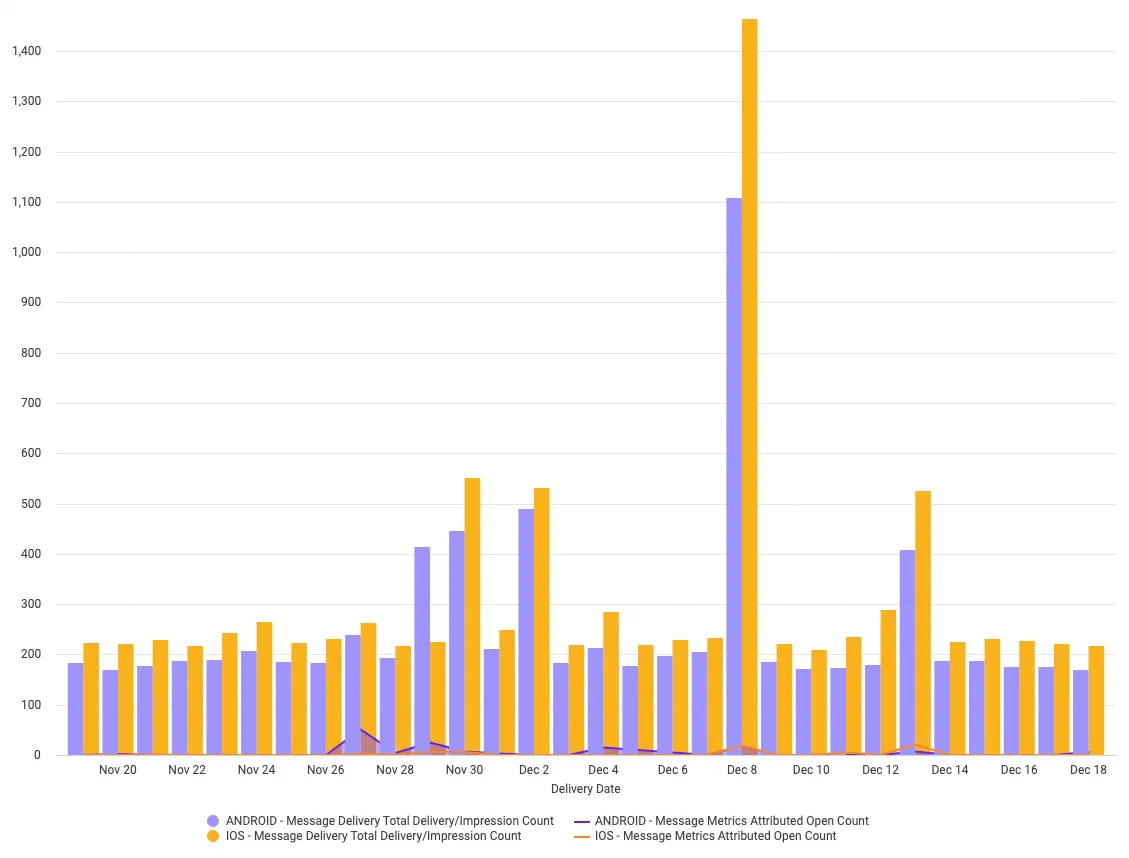 *The column visualization of a custom query from the Engagement Explore* To save your custom query for later access, follow the steps in [Saving Performance Analytics queries](https://www.airship.com/docs/guides/reports/analytics/tasks-queries/saving-queries/).