Create a message
Use the Message composer to send a single message to any channel.
To get started, select the Create dropdown menu (), then select Message. Next, enter a message name and save it. Select the settings icon () to mark it as a test.
After completing a step, select the next one in the header to move on.
Audience
In this step, define who you want to send your message to, and then set Channel CoordinationA group of strategies for targeting users where they are most likely to receive your message. and which channel types to include. You can also filter channels in your audience based on user data.
For projects using channel-level evaluation, configure the Audience step using the following options, as well as Localization. Channel coordination and channel conditions do not appear in those projects.
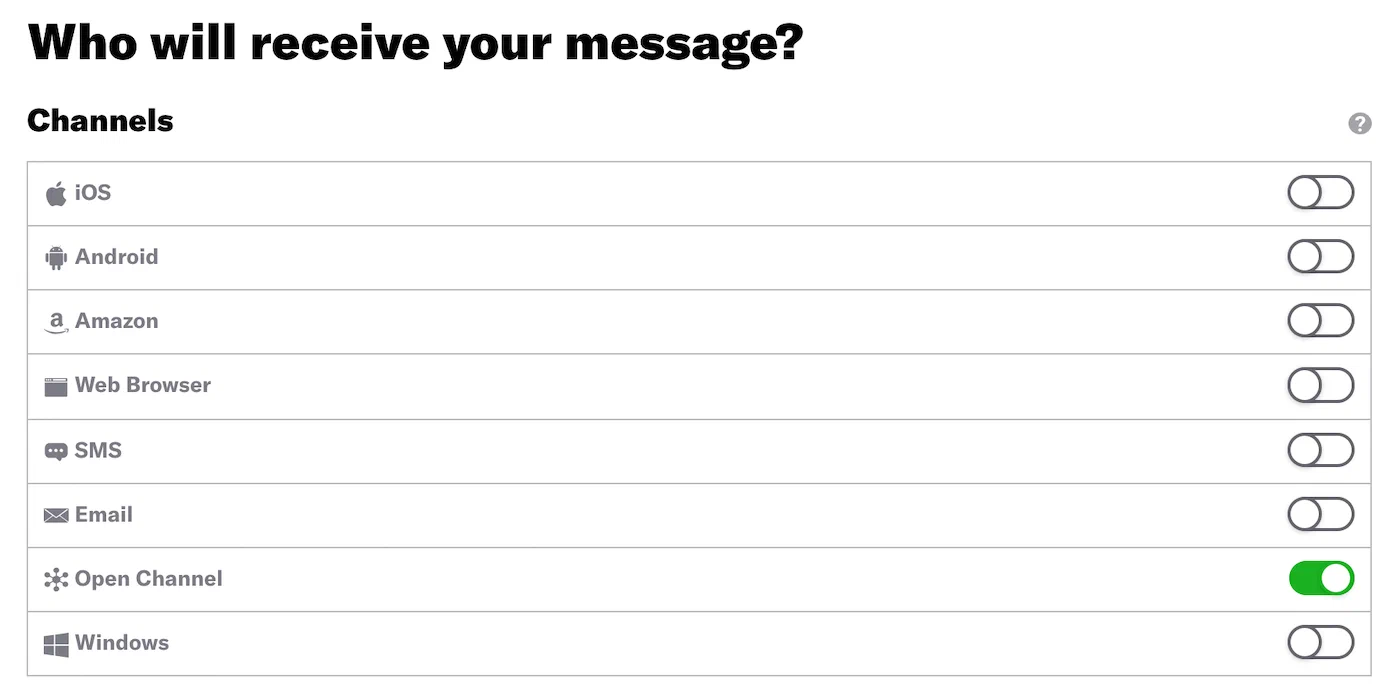
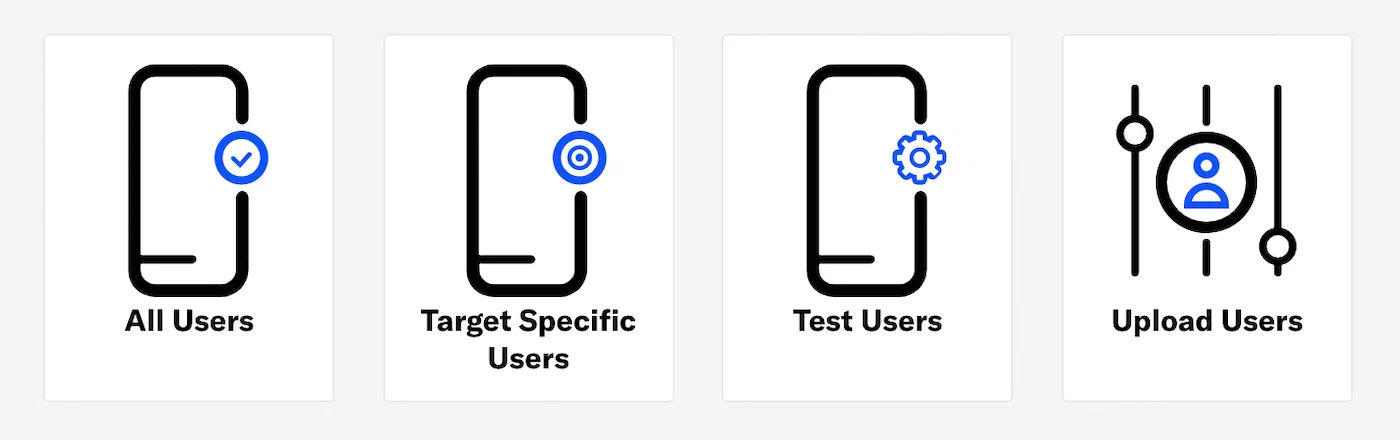
Enable the channels you want to send the message to, then choose a group of users.
| Option | Description | Steps |
|---|---|---|
| All Users | Your entire audience for the selected channels | n/a |
| Target Specific Users | Audience members in a group you define | Use the same process as when building a segmentA reusable audience group you create by selecting unique or shared user data.. |
| Test Users | Members of a preview and test groupAn audience group used for previewing personalized content and testing messages, app and website content, and Sequence runs. | Select a group. |
| Upload Users | Upload a list of users just before sending the message. | See Bulk Sending. |
To make this audience eligible for retargeting, enable Generate retargeting segments. This option is only available when your only selected channels are app platforms, web, and email.

Audience selection
Choose a group of users:
| User group | Description | Steps |
|---|---|---|
| Target by conditions | Include only users who meet conditions you define based on user data. | Use the same process as when building a segmentA reusable audience group you create by selecting unique or shared user data.. |
| Test group | Include the members of a preview and test groupAn audience group used for previewing personalized content and testing messages, app and website content, and Sequence runs.. | Select a group. |
| Upload a list | Upload a list of users just before sending the message. This option is only available when you have one of email, SMS, or an open channel enabled in Channel coordination. | See Bulk Sending. |
| All users | Include all users in your project for the selected channels. | n/a |
Channel coordination
First, select a Channel CoordinationA group of strategies for targeting users where they are most likely to receive your message. strategy:
- Fan Out targets a named user on all the channels they are opted in to, maximizing the chances they receive your message.
- Last Active targets a named user on the opted-in channel they used most recently.
- Priority Channel targets a named user on the first channel they are opted in to, in the priority order you set.
Then, enable the channel types to include in your audience. For Mobile Apps, also select from the available platforms. For Priority Channel, also drag the channel types into priority order.
Channel conditions
Use Channel conditions to filter which channels are included in the audience. Multiple conditions are handled as a Boolean AND, so a channel must meet all of them to remain in the audience.
For example, if your audience includes users with app, email, and SMS channels, and you set a channel condition requiring membership in an email subscription list:
- Only email channels that meet that condition would remain in the audience.
- All app and SMS channels would be excluded.
To set channel conditions, use the same process as when building a segmentA reusable audience group you create by selecting unique or shared user data.. For a list of available data, see Channel conditions in Audience data reference.
Localization
Enable Localization if you want to provide different content to app and web users depending on their language and country. See Localization.
Content
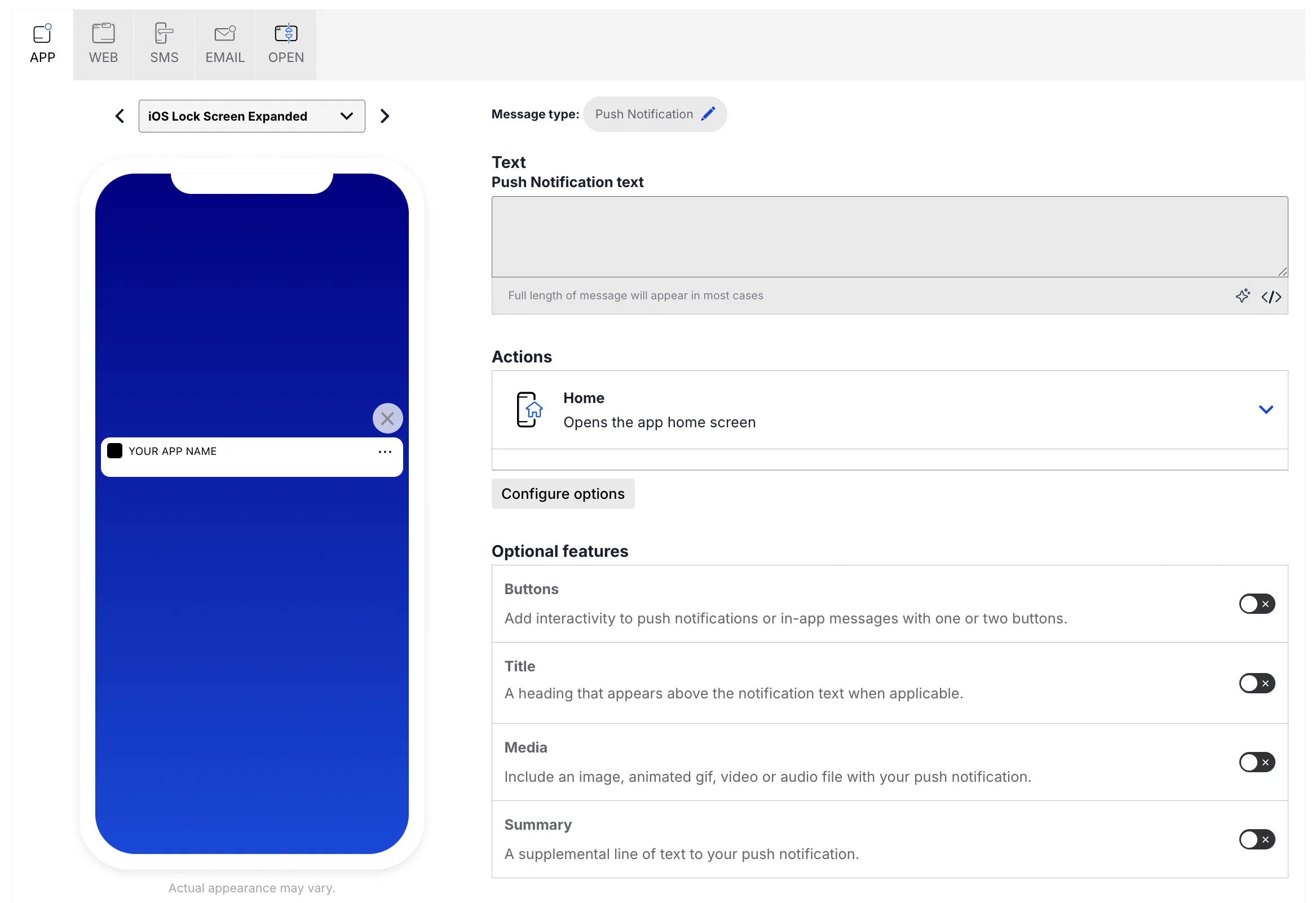
Configure the message content per enabled channel. See Content by channel and Localization.
Delivery
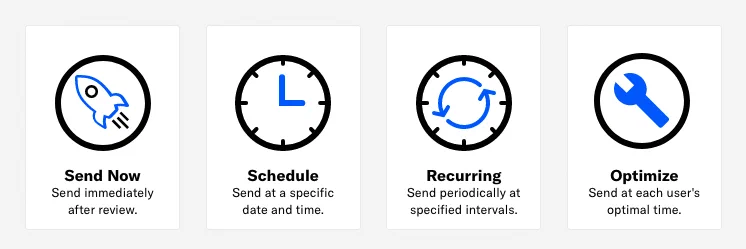
Configure delivery.
Review
Review the device preview and message summary. Select the arrows to page through the various previews. The channel and display type dynamically update in the dropdown menu above. You can also select a preview directly from the dropdown menu. If you want to make changes, select the associated step in the header, make your changes, then return to Review.
If you chose Target by conditions in the Audience step, select Generate audience count to see the following:
- The total number of contactsAny user in your project. Contacts are identified as either an anonymous contact or a named user. Airship can set targeting data on these identifiers, which are also used to map devices and channels to a specific user. and channels in the audience
- The total number of channels and the number of opted-in channels for each engagement channel and mobile app platform
You can also generate the audience count for the Target Specific Users legacy option, but it does not include the contacts count.
If you chose Upload a list or Upload Users in the Audience step, select Upload & Send and select your file. Uploaded merge field names will be verified against the merge fields set in the Content step. For more information, see Bulk sending.
To create an experiment with this message as a variant, select Create Experiment, then select A/B Test or Intelligent Rollout. You will leave the Message composer and go to the variants list in the new experiment. See Message A/B tests and Intelligent Rollouts.
Send a test message to verify its appearance and behavior on each configured channel. The message is sent to your selected recipients immediately, and it appears as a test in Messages Overview.
- Select Send Test.
Under Test audience, enter at least one named userA contact identified with an ID you provide, such as a customer ID from your CRM. Associating channels with that ID maps multiple devices and channels to one individual. Each named user has a unique named user ID. or preview and test groupAn audience group used for previewing personalized content and testing messages, app and website content, and Sequence runs. and select from the results. If your message includes email, you can also search for email addresses. If no matches appear for an address, you can select Create channel for <address>, and the channel will be registered for your project and opted in to transactional messaging.
Users in an active Holdout ExperimentMeasures the effects of excluding a group of audience members from all messages or messages with specific campaign categories. You can compare the performance of the two audience groups in reports for selected goal events. will not receive a test message. You can view a user’s current holdout group status and history when viewing their channel details in Contact Management.
(If your message contains HandlebarsHandlebars is Airship’s templating language for personalization. Handlebars expressions use double curly braces wrapped around a content template, ranging from a simple variable, e.g., {{first_name}}, to complex evaluations of personalization data.) Under Personalization, select and configure a personalization data source:
| Data source | Description |
|---|---|
| Use test audience stored attributes | The message will be personalized using attributesMetadata used for audience segmentation and personalization. Attributes extend the concept of tags by adding comparison operators and values to determine whether or not to target a user, helping you better evaluate your audience. associated with each test audience member. |
| Use JSON from the Preview Data tool | The message will be personalized using the data currently entered in the Preview Data tool. The same values will apply to all test message recipients. You can also manually edit the JSON. |
Select Send.
Select Send Message or Schedule Message.