Create a Scene
Set up multi-screen in-app experiences, with no development required. AXP
These steps walk you through creating a new SceneA mobile app or web experience of one or more screens displayed with fully native UI components in real time, providing immediate, contextual responses to user behaviors. Scenes can be presented in full-screen, modal, or embedded format using the default swipe/click mode or as a story. Scene content can also be displayed in a Message Center message and contain survey questions. using the Scene composer. You can also create a draft Scene from the Journey map then edit and complete the steps described here. See Create Journey components in the Journeys documentation.
Getting started
In the sidebar, select the Create dropdown menu (), then Scene. Next, enter a message name and save it. After completing a step, select the next one in the header to move on.
Settings
Configure optional features and set or verify the message purpose. Purpose only appears if enabled for the project.
Audience
In this step, define who you want to send your message to and which channel types to include. You can also filter channels in your audience based on user data.
First, determine who can see your message:
1. Configurations using the Feature flag access condition are excluded.
Next, under Delivery channels, enable the channel types to include in your audience. Channel type selection only appears if Web Scenes are enabled for the project.
For projects using channel-level evaluation, use the following steps for user group and channel configuration:
(If Web Scenes are enabled for the project) Select from channels: App and/or Web.
Select and configure a user group:
Option Description All users Include your entire app and/or web audience. Target specific users Include audience members in a group you define. See Audience targeting in Audience data reference. Test users Include members of a preview and test groupAn audience group used for previewing personalized content and testing messages, app and website content, and Sequence runs.. Feature flag audience Include members of a feature flagAn experimentation tool for controlling the availability of content or functionality in your app or website. A flag’s Configurations determine the audience, schedule, and property values to apply when the flag is enabled. Flag properties enable making immediate code updates, bypassing the need for traditional code changes and release processes. configuration audience1. You can search for a flag by name, display name, or description. 1. Configurations using the feature flag access condition are excluded.
Channel conditions
In the Journey map, this is labeled Device Conditions.
For projects using channel-level evaluation, channel conditions are instead set when using the Target Specific Users option for your message audience.
Use channel conditions to filter which channels are included in the audience. Multiple conditions are handled as a Boolean AND, so a channel must meet all of them to remain in the audience. See Channel conditions in Audience data reference.
Rollout
ADD-ON Rollouts for Scenes require the Feature Flags add-on for your Airship plan.
A rollout is a method of limiting a Scene’s total or targeted audience by setting an adjustable percentage. You can manually set the percentage of the audience or let Airship automatically increase it according to your settings. For more information, see Scene rollouts. This setting is not available when configuring the audience in the Journey map.
Set up a rollout:
Select All users, Target by conditions, or Target Specific Users. For Target by conditions and Target Specific Users, the percentage applies to users who meet the set conditions.
Enable Audience allocation.
Select an option and configure:
- Manual — Set a percentage. You can change the percentage at any time.
- Automated iOS SDK 21+Android SDK 21+ — Set starting and ending percentages and an end date. After starting the Scene, the starting percentage updates to display the current percentage. Users on older SDK versions will not be included in this rollout.
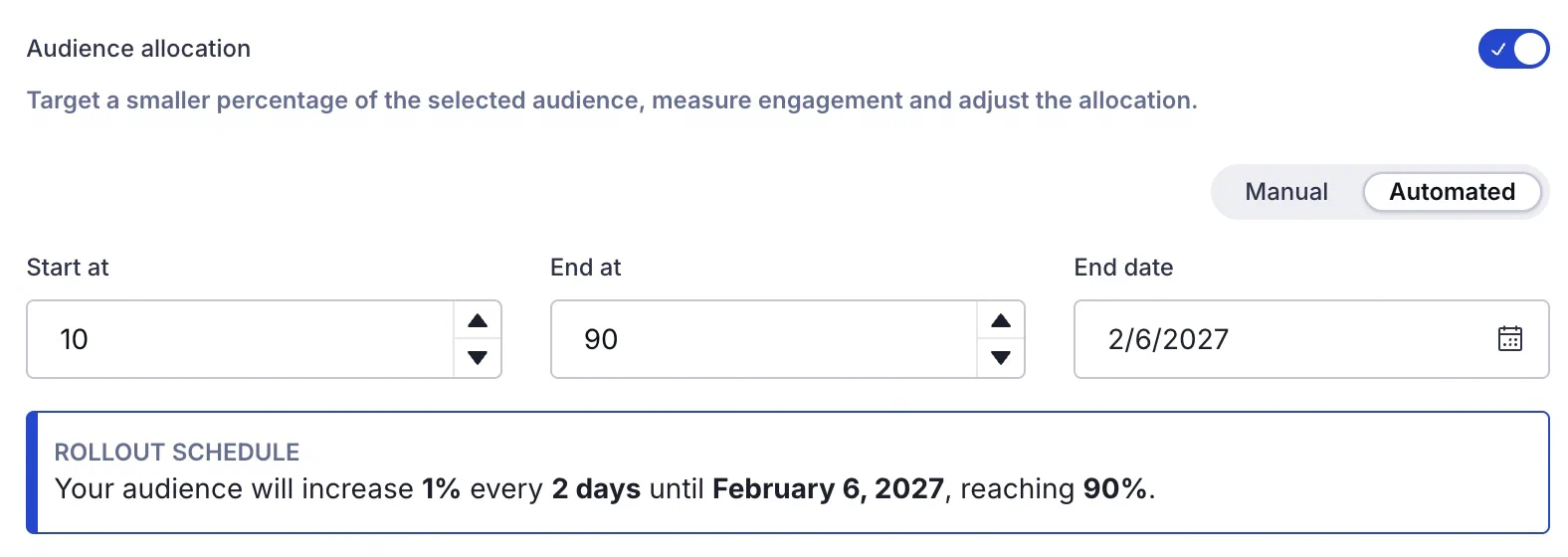
Configuring an automated rollout for a Scene
Switching from automated to manual pauses the increase at its current percentage. Switching to automated starts a fresh schedule. Disable Audience allocation to cancel and restore the audience to 100%.
If the Scene’s missed behavior is set to Cancel, or to Increment with a display limit of 1, the Scene won’t display for users who trigger it before they’re included in the rollout audience, even after the rollout increases to include them.
To display the Scene for these users once they’re included, set the behavior to Ignore.
Content
You can start with AI, manually design your content, provide custom HTML, or use a template.
AI design
Agentic & Generative AIUse a conversational chat interface to design your Scene content:
- Select Add content, then Start with AI, and then Continue with selection.
- Converse with the agent, and select Done to save.
- Select Edit content and configure settings for the entire Scene and the content of each screen. See the Scenes editor for configuration options and details.
- Select Done.
See Create Scene content using AI for usage details. You can also use the agent when editing content created using the manual, custom HTML, and template methods.
Manual design
Manually design your Scene content:
- Select Add content, and then select a starting point:
- Start from scratch — Create and configure each screen yourself.
- A default or custom content layout — Select a layout from the list.
- Select Continue with selection.
- Select Edit content and configure settings for the entire Scene and the content of each screen. See the Scenes editor for configuration options and details.
- Select Done.
Custom HTML
iOS SDK 20.1+Android SDK 20.1+Your HTML must be a single file containing all code. Any CSS, JavaScript, or images should be included inline or referenced via publicly accessible URLs.
Custom HTML content has the following limitations:
- Native Scene features are not available, including branching, storyA multi-screen content format where screens advance automatically. To create one, enable story mode for a Scene. mode, analytics tracking, or screen editing tools. All logic, including multi-screen navigation, must be handled by your HTML and JavaScript.
- Outside of your code, the only onscreen element you can configure is the Dismiss button.
- Personalization is not supported.
Provide custom HTML for your Scene content:
- Select Add content, then Custom HTML, and then Continue with selection.
- Select then Edit content and enter a publicly accessible URL. If your Airship plan includes CDN support, you also have the option to upload an HTML file.
- Configure settings for the entire Scene and the content of each screen. See the Scenes editor for configuration options and details.
- Select Done.
Template
Create or select a template for your Scene content:
- Choose Select template and then select a path:
- To use an existing template, select it, then Continue with selected template. You can search by name, keyword, or ID.
- To create a new template, select Create a new template, then follow the steps in Create a content template in the dashboard. After saving, you return to the message with your new template selected.
- Select Edit content and configure settings for the entire Scene and the content of each screen. See the Scenes editor for configuration options and details.
- Select Done.
Behavior
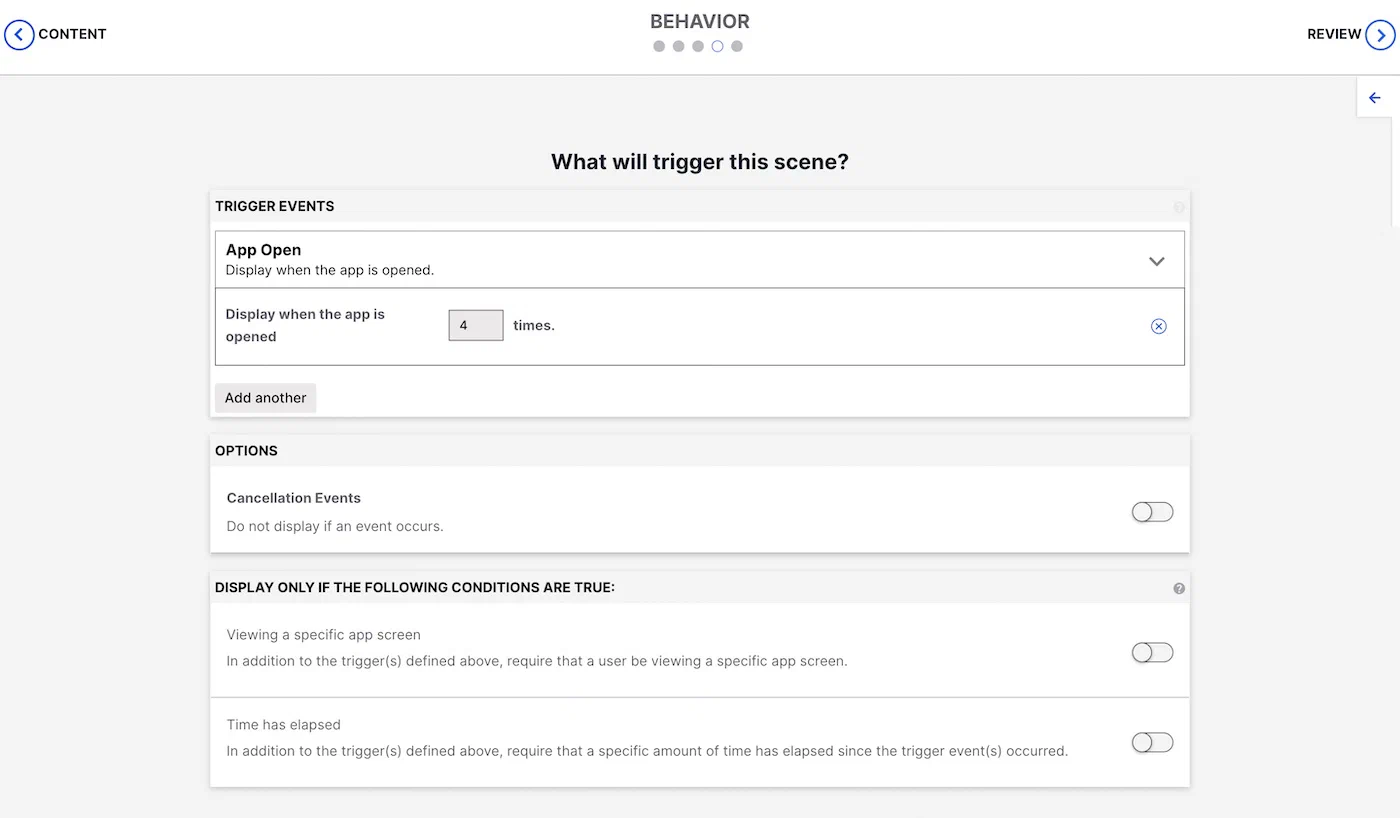
Configure the event that will cause the Scene to appear to users. You can also configure cancellation events and conditions for displaying the Scene.
Follow the steps in In-app experience triggers.
Review
Review your Scene’s appearance and summary.
- For Scenes with more than one screen, select the arrows at the side of the screen to page through each screen’s preview and content summary. Toggle the light and dark mode selector above the preview to see the appearance of elements with an assigned color setA named pair of hexadecimal color values supporting device light and dark modes. Color sets can be selected for any color field in a Scene and when configuring the default appearance of Scenes and In-App Automations. Dark mode is supported for Scenes only.. Light mode values appear in dark mode preview if no dark mode value was entered for a color set.
- If you selected Feature Flag Audience in the Audience step, compare the flag and Scene start and end dates in the Schedule section to make sure your intended timing is set up correctly.
- If you want to make changes, select Edit, make your changes, then either select the right arrow icon () or select the central navigation dot to return to the Review step.
Send a test to verify the Scene’s appearance and behavior on a mobile device. The test is sent as a push notification to your selected recipients immediately. Open the push to view the Scene. The test appears in Messages Overview.
- Select Send Test.
Under Test audience, enter at least one named userA contact identified with an ID you provide, such as a customer ID from your CRM. Associating channels with that ID maps multiple devices and channels to one individual. Each named user has a unique named user ID. or preview and test groupAn audience group used for previewing personalized content and testing messages, app and website content, and Sequence runs. and select from the results. If your message includes email, you can also search for email addresses. If no matches appear for an address, you can select Create channel for <address>, and the channel will be registered for your project and opted in to transactional messaging.
Users in an active Holdout ExperimentMeasures the effects of excluding a group of audience members from all messages or messages with specific campaign categories. You can compare the performance of the two audience groups in reports for selected goal events. will not receive a test message. You can view a user’s current holdout group status and history when viewing their channel details in Contact Management.
(If your message contains HandlebarsHandlebars is Airship’s templating language for personalization. Handlebars expressions use double curly braces wrapped around a content template, ranging from a simple variable, e.g., {{first_name}}, to complex evaluations of personalization data.) Under Personalization, select and configure a personalization data source:
| Data source | Description |
|---|---|
| Use test audience stored attributes | The message will be personalized using attributesMetadata used for audience segmentation and personalization. Attributes extend the concept of tags by adding comparison operators and values to determine whether or not to target a user, helping you better evaluate your audience. associated with each test audience member. |
| Use JSON from the Preview Data tool | The message will be personalized using the data currently entered in the Preview Data tool. The same values will apply to all test message recipients. You can also manually edit the JSON. |
Select Send.
Select Finish to make the Scene active. If you exit before selecting Finish, the Scene is saved as a draft.