Scenes editor
Use the Scenes editor to create Scene content and determine appearance and behaviors.
The Scenes editor is the built-in editor for creating Scenes, custom content layouts, and Scene templates. Scene templates can be used directly in Scenes, in Message CenterAn app inbox where you can display rich messages. The messages support native content, HTML, video, and more. Scenes, and for Scenes opened from push notifications. The editor supports configuring appearance, behavior, and branching.
Scene features include tracking and analytics functionalities. Depending on your implementation, these features may store or access information on end users’ devices. Different locations may have varying legal and privacy requirements regarding tracking technologies and user consent. Please verify with your legal or regulatory compliance team that your use of Scenes, including any tracking and analytics configurations, complies with applicable consent and transparency requirements under local laws and regulations.
This content is provided for informational purposes only and is not intended to be, nor should be relied on as, legal or compliance advice.
Configuration sections
The following describes each configuration section in the Scenes editor. After completing configuration, select Done.
Behavioral settings
Select the settings icon () in the left sidebar to configure behavioral settings that apply to the entire Scene. Follow the steps in Scene behaviors.
Screens
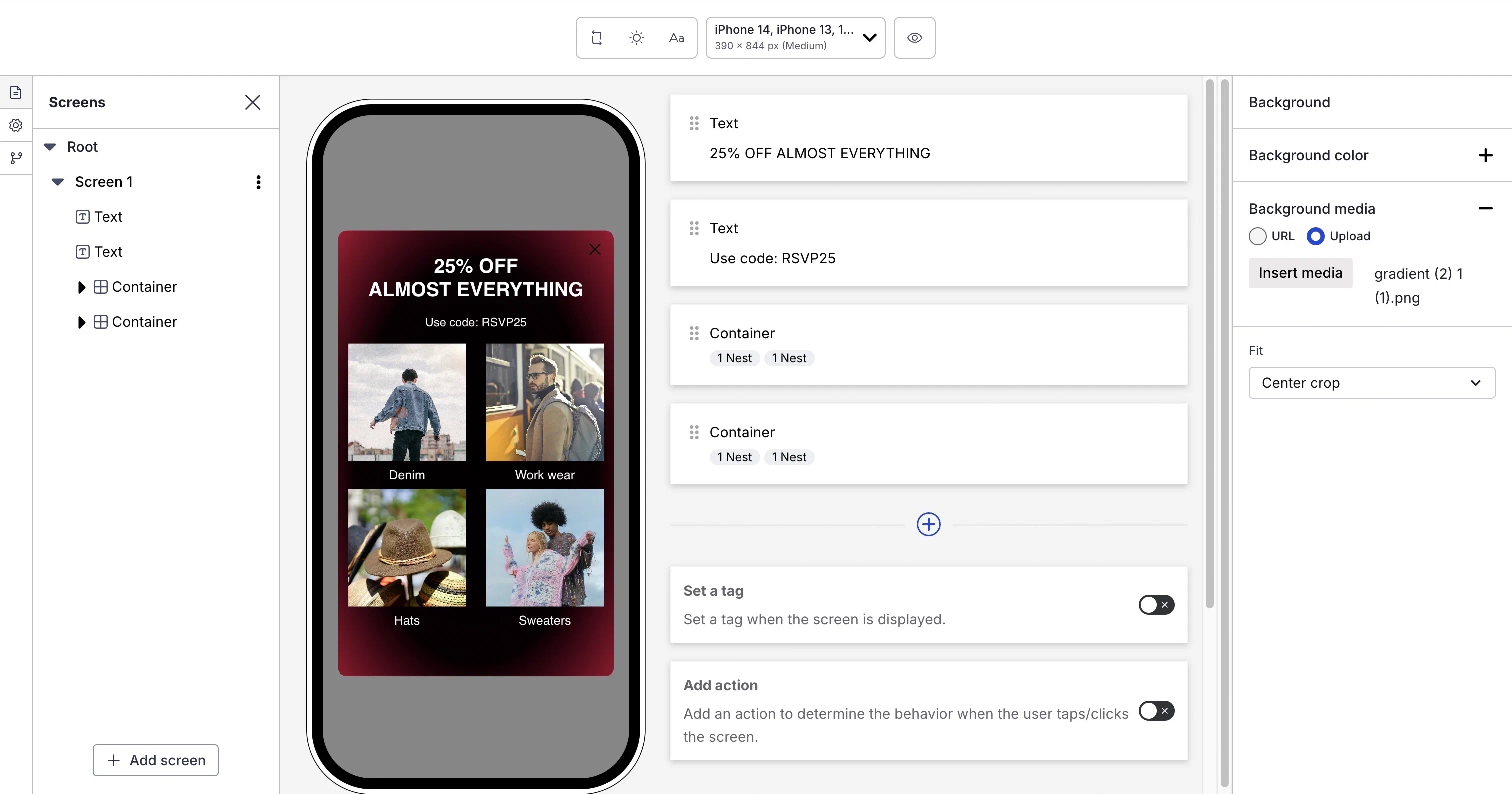
Select the screens icon () in the left sidebar to configure the appearance of your screens. For settings that apply to all screens, follow the steps in Root appearance. For individual screens, see Configuring screens. Screen configuration is limited when using custom HTML for your content.
Branching
Select the branching icon () to create a custom user path through multiple screens. See Scene branching.
External data feeds
An external data feed is a connection to an external API. When you send a message, Airship uses a response from that API to personalize messages. Select the data feeds icon () in the left sidebar to access preformatted feed blocks and object locations. For setup and usage information, see External data feeds.
Accessibility audit
Agentic & Generative AI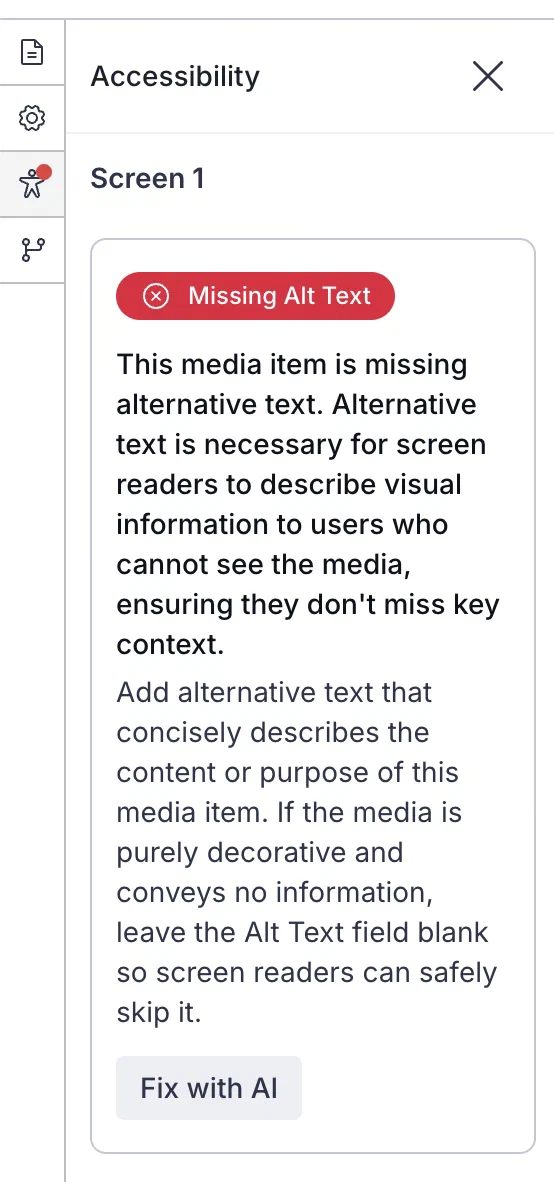
The accessibility agent automatically audits your content and identifies potential accessibility issues. Addressing them helps ensure your content is usable by the greatest number of audience members, including those with disabilities.
While editing screens, when an accessibility issue is found, a red dot appears on the accessibility audit icon () in the left sidebar. Select the icon to view the list of flagged issues. Each issue includes:
- A description of the problem
- The screen and element where it occurs
- Guidance on how to address it
- A button labeled with the recommended correction
Select the button to apply the correction, and then verify each automatically applied fix to ensure it meets your needs and maintains your intended messaging. AI-powered corrections are labeled “Fix with AI”.
You are responsible for reviewing all automatically applied fixes before launching your Scene. Automated fixes may not always align with your specific content requirements or brand guidelines. For comprehensive accessibility guidance and best practices, see Accessibility in messaging.
The following issues can be automatically fixed:
| Issue type | Description |
|---|---|
| Insufficient color contrast | These are color contrast ratio issues between content elements, such as indicator colors versus background colors. The agent presents issues for both light and dark modes. The fix adjusts colors to meet WCAG contrast ratio requirements. |
| Text not marked as heading | These are text items that visually appear to be headings, such as bold or larger font, but are not marked with a semantic H1-H6 tag. The fix applies an appropriate heading level based on the text’s position and styling. |
| No headings in screen | This flags content if no Text elements are designated as headings (H1-H6). The fix suggests appropriate heading levels for Text elements that appear to be headings. |
| Heading order | This identifies and recommends fixes for out-of-order heading structure. The fix adjusts heading levels to create a logical hierarchy. |
| Text size below minimum | This is text that does not meet minimum readability recommendations. The fix adjusts the font size to meet accessibility standards. |
| Images containing text | This is any image that contains text, which screen readers cannot interpret. The fix adds or updates the alternative text field to describe the text within the image. |
| Missing alternative text | This is any image that lacks descriptive alternative text. The fix uses AI to generate descriptive alternative text for the image. |
| Missing content descriptions or accessibility label associations on inputs | These are input fields that lack content descriptions or accessibility label associations. The fix uses AI to generate content descriptions. For accessibility labels, the fix always generates a content description but does not suggest label relationships with text inputs. |
| Missing content descriptions on buttons | These are buttons that lack content descriptions. The fix uses AI to generate descriptive content descriptions for buttons. |
| Non-scrollable Container with text | This flags a Container that contains text but has the Scrollable setting disabled. Without scrolling, text that expands when a user increases their device font size can be cut off or overlap other elements, which may not meet WCAG resizing standards. The fix enables scrolling for the Container. |
| Gesture conflict for stories | This flags a Scene with story mode enabled that has both Swipe to dismiss enabled and a scrollable Container. Users may accidentally dismiss the Scene when trying to scroll. The fix disables swiping to dismiss. |
Opting In to AI Functions
If you opted out of AI usage, you must sign an updated contract to enable this feature. Contact your account manager for assistance.
Compliance Considerations in Using AI Functions
The Service incorporates AI functions, including Generative AI and Agentic AI.
Generative AI generates content such as Notification copy, images, and Journeys based on your prompts.
Agentic AI autonomously optimizes, personalizes, or executes cross-channel customer engagement actions, or analyzes audience and performance data, subject to the parameters and controls you set in the Service. These systems operate under human-defined parameters and do not initiate customer-facing actions without human interaction or pre-configured parameters. You are responsible for reviewing Generated Outputs for accuracy, appropriateness, and to ensure they do not violate third-party intellectual property or other rights. Airship does not publish Generated Outputs to end users without approval from the Customer.
In addition to the applicable terms of your agreement with Airship (e.g., Use of Service, Customer Responsibilities sections), you must comply with the Airship Acceptable Use Policy, which provides additional details about appropriate conduct when using the Service.
The Service includes safety features to block harmful content, such as content that violates our Acceptable Use Policy. You may not attempt to bypass these protective measures or use content that violates your agreement with Airship.
About the AI models:
Airship utilizes Google Gemini and Imagen to generate copy and images for AI Scene screens. The content is created solely with Google’s out-of-the-box models, and no customization or fine-tuning with Customer Data is applied. See Responsible AI in Google’s Google Cloud documentation.
Version snapshots
The system automatically generates a snapshot after each accessibility agent fix and Scenes AI agent update, ensuring you can revert a Scene to a previous version if needed.
Select Snapshots to view the 10 latest entries. Each one shows the change that occurred, the affected screen and element, and the date and time. Select an entry to revert the Scene to that point.
Select the remove icon () to delete an entry from the list. Snapshots are automatically removed after 30 days.
Preview tools
The device preview updates as you type and make selections. Use the tools in the header to adjust the preview.

Available tools:
| Tool | Description |
|---|---|
| App/Web format | Select the grid icon () for App or the globe icon () for Web to display the content as it will appear in an app or website. The buttons only appear when both App and Web are enabled. See Audience in Create a Scene. |
| Orientation | Toggle the device orientation icon () to see how the content appears when the device or monitor is rotated. |
| Light and dark mode | Toggle the sun icon () and moon icon () to see how elements with an assigned color setA named pair of hexadecimal color values supporting device light and dark modes. Color sets can be selected for any color field in a Scene and when configuring the default appearance of Scenes and In-App Automations. Dark mode is supported for Scenes only. appear in each mode. Light mode values appear in dark mode preview if no dark mode value was entered for a color set. |
| Text scaling | Use the text scale tool to see how the content will appear on devices using text size accessibility features. You can scale between 70% and 200% of the current text size. |
| Device/Screen size | Select a device or screen size to see a more accurate representation of how your content will appear on a specific screen size. |
| Interactive mode | Select the preview icon () to enter Interactive mode and test the interactive elements of your screens. You can swipe between screens or select buttons or other elements configured with Next or Previous actions. When storyA multi-screen content format where screens advance automatically. To create one, enable story mode for a Scene. mode is enabled, select the play icon () or pause icon () to test automatic screen transitions and background video playback. Select the reload icon to reset and return to the first screen. |
| Preview Data | See how the personalized content appears using values for a selected user or your own JSON sample data. Follow the steps in Previewing personalized content. |
For best results, always test your content on actual devices.
Markdown styling
Markdown is a markup language for formatting text. Scene content supports basic Markdown. Use Markdown in text fields in any content element.
These styles require minimum SDK versions:
| Style | Syntax | Output |
|---|---|---|
| Bold | **Hello** or __Hello__ | Hello |
| Italic | *Hello* or _Hello_ | Hello |
| Strikethrough | ~Hello~ | |
| Link¹ | [Hello](https://www.example.com/hello) | Hello |
| Highlight | ==Hello== | Hello |
| Subscript | H,{2},O | H2O |
| Superscript | x^^2^^ | x2 |
1 Links are not underlined and use the default link color for the platform. On web, the color is blue unless overridden by CSS. On iOS, it is the app’s accent color. On Android, it is the theme’s linkTextColor.
Personalization
You can personalize your content using HandlebarsHandlebars is Airship’s templating language for personalization. Handlebars expressions use double curly braces wrapped around a content template, ranging from a simple variable, e.g., {{first_name}}, to complex evaluations of personalization data. to display different text or media for each user. For example, you can display a question in different languages based on the user’s locale attribute. Common places to personalize include:
- Screen titles and descriptions
- Button labels
- Questions and NPS content
- Input field placeholders
- Media URLs
See Personalization for more information about using Handlebars in your content.